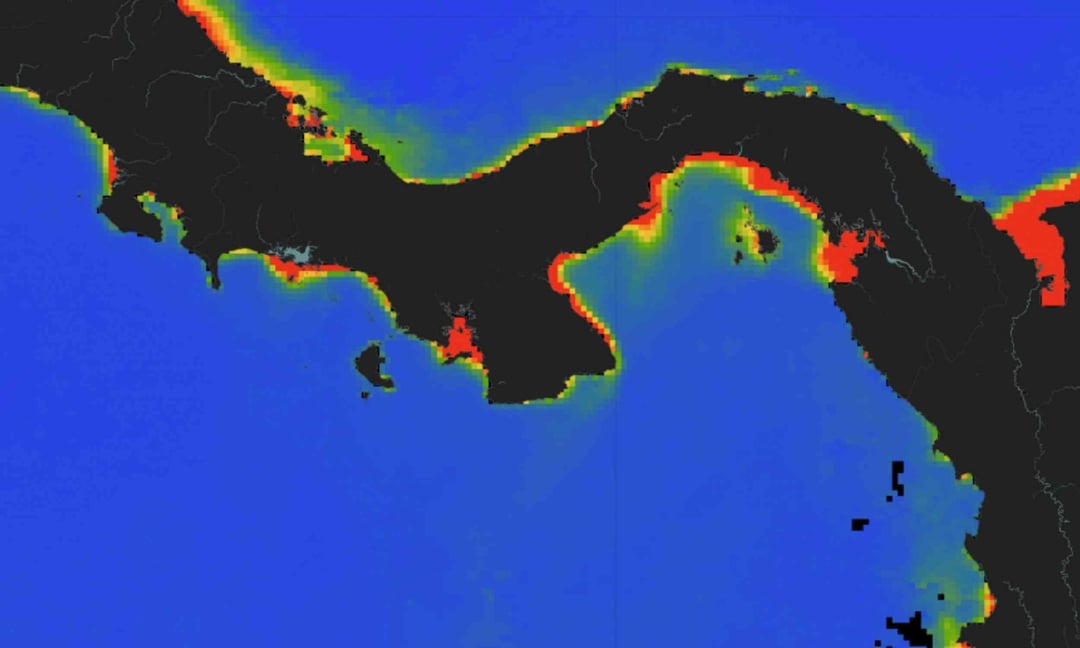
Every year during Central America’s dry season—typically between December and April—strong winds play a quiet but crucial role in shaping life in the Gulf of Panama. These winds push warm surface water away, allowing colder, nutrient-rich water from the deep ocean to rise.
This process, known as Upwelling, is vital to the region. It supports thriving fisheries, helps protect coral reefs from overheating, and keeps coastal waters cooler during the peak holiday season.
For decades, scientists at the Smithsonian Tropical Research Institute have monitored this cycle. Their records show that the upwelling has been consistent and predictable for at least 40 years—until now.
In 2025, something unusual happened. For the first time on record, the upwelling did not occur as expected. The typical cooling effect was noticeably weaker, and the boost in ocean productivity that usually follows was significantly reduced.

Researchers believe a sharp drop in wind strength may be responsible. In a study published in Proceedings of the National Academy of Sciences, they suggest that weakened wind patterns disrupted the entire process. It’s a striking example of how sensitive ocean systems are—and how quickly they can be affected by climate changes.
Still, scientists say more research is needed to fully understand what caused the disruption and what it could mean for marine life and fishing communities that depend on these waters.
The findings also highlight a bigger issue: tropical ocean systems like this are not as closely monitored as they should be. As climate pressures increase, experts warn that better observation and forecasting will be essential to protect both ecosystems and livelihoods.
The research forms part of a broader collaboration involving the Max Planck Institute for Chemistry and its vessel, the S/Y Eugen Seibold, working alongside STRI to better understand changes in ocean dynamics.