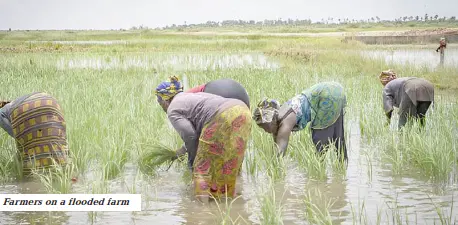
Members of the House of Representatives have disagreed over a proposal to cancel outstanding loans obtained by farmers under various Federal Government agricultural intervention programmes, with lawmakers divided over whether struggling farmers should receive debt relief or face investigations into the use of the funds.

The proposal, sponsored by Inuwa Garba, representing Yamaltu/Deba Federal Constituency of Gombe State, seeks to relieve farmers who have been unable to repay government-backed agricultural loans due to insecurity, climate change, natural disasters and other challenges affecting agricultural production.
The affected programmes include the Anchor Borrowers’ Programme, Commercial Agriculture Credit Scheme and facilities supported by the Nigeria Incentive-Based Risk Sharing System for Agricultural Lending (NIRSAL).
Leading the debate on the motion, Garba argued that insecurity, banditry, insurgency, farmer-herder clashes, flooding and drought had severely disrupted farming activities, resulting in crop failures, loss of investments and reduced incomes for farmers.

He maintained that many beneficiaries had defaulted on their loan repayments not because they were unwilling to pay, but because circumstances beyond their control had affected their ability to sustain agricultural production.
According to him, continued enforcement of outstanding debts, including interest and penalties, could worsen the financial difficulties of already struggling farmers, expose them to asset seizures and discourage participation in future agricultural programmes.
However, Bamidele Salam, representing Ede South/Ede North/Ejigbo/Egbedore Federal Constituency of Osun State, opposed a blanket cancellation of the loans, citing alleged widespread abuse of the agricultural financing schemes.

Salam, who chairs the House Committee on Public Accounts, referred to findings in an Auditor-General for the Federation’s report before the House, alleging that some beneficiaries diverted agricultural loans worth more than N1 trillion into businesses and investments unrelated to farming.
He claimed that some beneficiaries who obtained loans through the Central Bank of Nigeria and commercial banks used the funds to acquire properties in Abuja, Lagos and Dubai instead of investing in agricultural activities.
He also raised concerns about the financial position of the Bank of Agriculture, alleging that it had been severely weakened by N795bn in outstanding loans owed by beneficiaries, many of whom reportedly diverted the funds.
Salam warned that approving a blanket waiver without first investigating how the loans were spent could encourage further abuse of government intervention programmes.

He argued that allowing beneficiaries who misused public funds to escape repayment would establish a dangerous precedent for future agricultural financing initiatives.
Similarly, Isiaka Ibrahim, a lawmaker from Ogun State, supported calls for caution, alleging that some beneficiaries had diverted government-backed agricultural loans to personal interests, including additional marriage arrangements.
He, however, acknowledged that a comprehensive investigation could help identify genuine farmers whose businesses had been affected by economic hardship and who were consequently unable to repay their loans.
Another lawmaker, Paul Kalejaiye, representing Lagos State under the All Progressives Congress, also urged the House to investigate how the funds were utilised before taking a decision on debt forgiveness.

The disagreements prevented lawmakers from reaching a consensus on the proposal, prompting the House to postpone further consideration of the motion until Tuesday, November 24.
The proposed loan cancellation has highlighted the challenge of balancing financial relief for farmers affected by insecurity, environmental disasters and economic hardship with accountability for public funds committed to agricultural development.
The outcome of the deliberations could have significant implications for the recovery of government-backed agricultural loans, the credibility of future intervention programmes and Nigeria’s efforts to strengthen food production.