

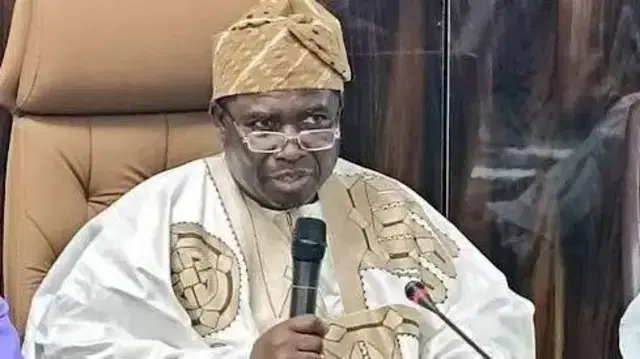
At the Shehu Musa Yar’Adua Centre in Abuja, a simple question from lawyer, veteran Nollywood actor, and political commentator Kenneth Okonkwo is at the center of a growing political storm.
Dressed in a dark traditional outfit and patterned grey cap, Okonkwo leans slightly forward, eyes wide, brows raised. Around him, polished floors, pillars, and small clusters of observers stand in tense silence. Then he asks:
“How can ‘status quo ante bellum’ mean a political party has no leadership? What was the state before the conflict? Has there ever been a time the ADC had no leadership?”

The moment is less legal argument than a framing of a political conflict.
A Press Conference That Broke Its Bounds
As Okonkwo speaks, former Senate President and embattled National Chairman of the African Democratic Congress (ADC), Senator David Mark, steps forward. Surrounding him are political heavyweights: former Vice President Atiku Abubakar; former governors Peter Obi, Rabiu Kwankwaso, Rauf Aregbesola, Liyel Imoke, Rotimi Amaechi; senators Aminu Tambuwal and Dino Melaye; alongside activists and party supporters.

The crowd forces the briefing outdoors. Mark raises the stakes:
“There is only one conclusion Nigerians can draw. The electoral umpire has taken sides. It can no longer be trusted.”
“With 90% of the National Assembly and over 30 governors, what are you afraid of?” he asks President Bola Ahmed Tinubu.
The INEC Move That Changed the Game
Between Wednesday and Thursday, INEC removed the names of David Mark, Rauf Aregbesola, and the ADC National Working Committee from its portal, stepping back from recognising or monitoring any faction.

While INEC cites a March 12 Court of Appeal order to maintain the ‘status quo ante bellum,’ its interpretation effectively erased the party’s leadership rather than preserving it. Legal practitioners note that maintaining status quo usually implies freezing conditions, not dismantling them.
The timing is notable: the delisting came shortly after mass defections to the ADC from other parties, and just before the party’s scheduled congresses, which determine control before primaries. INEC has not clarified why it chose such a sweeping action.
ADC’s Response: Holding Ground
Bolaji Abdullahi, ADC National Publicity Secretary, said:
“We are not going to yield because yielding makes us complicit in fostering dictatorship. Our duty is to Nigeria and to Nigerians. This is another test for democracy, and we will be firm and resilient.”

The party plans to proceed with congresses from April 9, though the absence of INEC recognition casts uncertainty over every step.
Timeline of the Crisis
- September 9, 2025: David Mark-led leadership formally recognised by INEC
- March 12, 2026: Court of Appeal orders all parties to maintain ‘status quo ante bellum’
- Days later: INEC removes names from portal
- April 9: ADC congresses scheduled to begin
- April 23–May 30: Primaries
- May 10: Party membership register submission

Public Reactions
The crisis has triggered sharp criticism and suspicion:
- Peter Obi: “Defenders of democracy now its destroyers… power reveals character.”
- Social commentators: Many accuse INEC of bias, overreach, or deliberate sabotage ahead of 2027.
- Political strategists: Urge ADC to consolidate its base nationwide despite INEC’s actions.
The Question That Lingers
Even as the crowd disperses, Okonkwo’s question resonates:
“How can ‘status quo ante bellum’ mean a political party has no leadership?”
Silence in response speaks volumes, highlighting the deep uncertainty ADC now faces in the run-up to critical congresses and the 2027 elections.




