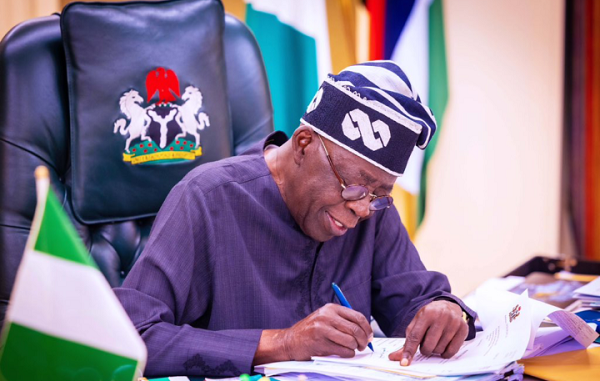
PCC outlines financing, improved inputs, mechanisation and market support to expand food production and strengthen national food security.
By Princess Gloria Adebajo-Fraser, MFR, MBA, MIoD, FIPMD
Nigeria’s food security ambitions depend on turning its vast agricultural resources into productive farms, dependable harvests and affordable food. President Bola Tinubu’s administration is committing substantial financing to that task, combining a ₦1.5 trillion Bank of Agriculture recapitalisation with ₦450 billion in programmes supporting production and commodity markets.

In a statement issued on Sunday, November 22, 2026, Dele Alake, spokesperson for the APC Presidential Campaign Council, said interventions through the bank had reached more than 500,000 smallholder farmers, with particular attention to Northern Nigeria.
The measures bring together credit, improved inputs, mechanisation, irrigation, storage and market access—essential foundations for strengthening Nigeria’s capacity to feed its people.
The approach reflects the President’s commitment to domestic production:

“We will continue to drive local production and ensure that we produce what we eat and use locally.”
— President Bola Ahmed Tinubu, in remarks delivered on his behalf by Vice President Kashim Shettima at the public presentation of Chief Olusegun Osoba’s My Life in the Public Eye, Lagos, July 13, 2024.
₦250 BILLION SMALLHOLDER FUND
According to Alake’s statement, the ₦250 billion Renewed Hope Smallholder Support and Value Chain Fund finances farmers through Farmer Aggregation Companies coordinating registration, input distribution, extension services and market connections.

The programme has reached over 500,000 smallholders across 16 states, including more than 70,000 women. Approximately 2.5 million bags of fertiliser and 300,000 bags of certified seeds have been distributed.
Its wider target is to reach two million farmers and distribute more than 10 million bags of fertiliser.
Kaduna, Kano, Katsina, Niger, Borno, Gombe, Taraba, Adamawa, Yobe and Bauchi were identified among states receiving attention. The council emphasised the significance of these interventions in Northern Nigeria, where agriculture remains a major source of livelihood and economic activity.

₦200 BILLION TO SUPPORT COMMODITY MARKETS
The second component of the ₦450 billion commitment is the Guaranteed Minimum Price Programme, valued at ₦200 billion.
Under this initiative, the Bank of Agriculture has procured approximately 170,000 metric tonnes of maize, rice, sorghum and cassava, the statement said.
The programme is designed to strengthen commodity markets and protect farmers against distress sales. It addresses the pressure producers face when immediate financial needs or inadequate storage force them to sell cheaply after harvest.
Connecting production support with dependable market opportunities can help farmers recover their investment and prepare for subsequent planting seasons.

ONION FINANCING AND STORAGE
The bank has developed an Onion Financing Programme with the National Onion Producers, Processors and Marketers Association of Nigeria, representing over 11,800 onion farmers.
The scheme provides for improved seeds and fertiliser, commodity purchase financing for processors, and the development of storage and solar-powered cooling facilities to reduce post-harvest losses.
Cooperatives will contribute 30 per cent of their input costs, while the bank finances the remaining 70 per cent.
According to the council, this arrangement will strengthen production, improve farmers’ incomes and expand market access, particularly in Northern Nigeria.

₦1.5 TRILLION TO EXPAND AGRICULTURAL LENDING
The approved recapitalisation is intended to strengthen the Bank of Agriculture’s capacity to provide affordable and accessible funding to farmers, cooperatives, processors, aggregators and other agricultural businesses.
Alake’s statement described the measure as a major step towards fulfilling the President’s campaign commitment to strengthen agricultural financing.
A better-capitalised bank would be positioned to support larger investments, expand services to underserved farming communities and mobilise additional resources for domestic production.

The council also linked the administration’s agricultural agenda to support for cultivation across 500,000 hectares, reinforcing the connection between institutional financing and expanded productive activity.
NIGERIA’S LAND RESOURCES
Nigeria has approximately 70.8 million hectares of agricultural land, including about 34 million hectares of arable land, according to the Federal Ministry of Agriculture’s National Agri-Food Systems Investment Plan, citing the Food and Agriculture Organization.
These resources provide a substantial foundation for increased cultivation, rural employment and agro-processing. Developing that potential requires investment in farmers, water management, equipment, storage and transport.
The importance of harnessing these agricultural resources is also explored in Nigeria’s Great Reset: Rebuilding today for a prosperous tomorrow, which examines agriculture’s contribution to economic renewal and national food security.

SPIN: STRENGTHENING IRRIGATION
Complementing agricultural financing is the $500 million World Bank-assisted Sustainable Power and Irrigation for Nigeria project, known as SPIN.
Approved in September 2024, it targets improved irrigation and drainage services across 40,000 hectares. Up to 950,000 people, including farmers, households and livestock breeders, are expected to benefit from more reliable water services and increased agricultural productivity. The project also supports dam safety and water management.
Reliable irrigation supports cultivation beyond seasonal rainfall, giving farmers greater confidence to plan production and strengthening resilience to drought.

DRY-SEASON FARMING, GINGER AND WOMEN
The PCC statement said the bank is working with the All-Farmers Association of Nigeria on a dry-season financing pipeline targeting 400,000 farmers for the 2026 farming cycle.
This includes 120,000 hectares of wheat and another 300,000 hectares for rice, maize, sorghum, millet, cassava and soybeans.
The Nigeria Ginger Recovery Programme has supported 3,200 farmers in Kachia, Kaduna State, with blight-free seeds. More than 9,000 bags have been recovered for multiplication, with expansion planned across 20,000 hectares in 16 states.
At least 50,000 women are also being targeted through insured cooperative production financing at nine per cent, in partnership with the Federal Ministries of Women Affairs and Agriculture.

MECHANISATION AND SOLAR SUPPORT
Under the Renewed Hope National Agricultural Mechanisation Programme, 1,571 tractors have been deployed across 23 states, according to the council.
They are expected to serve 1.2 million hectares through qualified Mechanisation Service Providers.
Separately, a ₦385 billion productive-use-of-electricity programme provides for 44,000 electric cargo tricycles and 100,000 solar irrigation pumps, targeting 500,000 farming families. Youth participation and commercial poultry production feature among other interventions.
These programmes reflect a wider development principle: productive agriculture sustains livelihoods, supplies industry and supports national stability.

“If agriculture fails, everything else will fail.”
— Professor M. S. Swaminathan, agricultural scientist and father of India’s Green Revolution.
His warning places agricultural investment in its proper national context. Financing farmers, improving irrigation and protecting harvests strengthen the foundations on which food security and economic resilience depend.
NATIONAL PATRIOTS POSITION
National Patriots commends the administration’s substantial commitments to domestic production and rural livelihoods.
“Food security begins with empowering those who feed the nation. President Tinubu’s interventions recognise that farmers need affordable finance, reliable inputs, modern equipment and dependable markets. Stronger lending, irrigation and storage can turn Nigeria’s enormous agricultural resources into productive opportunities, better incomes and affordable food for families.”
— National Patriots

Nigeria’s agricultural strength must be felt in the farmer’s income, the trader’s supply and the family’s food basket. The financing commitments and production programmes outlined by the administration provide a substantial platform for that progress including a strong case for continuity and re-election.
National Patriots urges sustained delivery across farming communities so that investment becomes harvest, harvest becomes prosperity, and food security becomes a dependable foundation of national strength.
Princess Gloria Adebajo-Fraser, MFR, MBA, MIoD, FIPMD
President, National Patriots
Member, APC-PCC Strategic Communications Committee 2027