

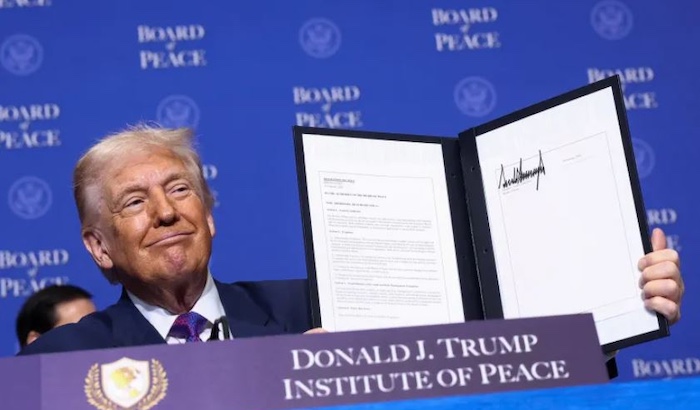
United States President Donald Trump has formally declared the war in Gaza over, launching a multibillion-dollar reconstruction and international stabilisation initiative that he described as the start of a “new chapter” for the territory.

Speaking in Washington, DC, on Thursday, February 19, 2026, Trump positioned the announcement as a definitive end to the conflict that began in October 2023, rather than a temporary ceasefire.
“This is about making the peace stick,” he said, introducing the newly formed Board of Peace as the central mechanism to turn battlefield silence into lasting stability.

While the declaration carries significant political weight, analysts and regional observers note that no comprehensive political settlement or formal disarmament agreement involving Hamas has been publicly confirmed. Previous truces have proven fragile, and experts warn that without binding guarantees against renewed military escalation, the situation could deteriorate rapidly.

Israeli Prime Minister Benjamin Netanyahu endorsed the reconstruction framework, while Foreign Minister Gideon Sa’ar called it the first plan to address the “root causes” of the conflict, including disarmament of militant groups and demilitarisation of Gaza.

Trump announced a reconstruction pledge totaling $17 billion, with the United States committing $10 billion and regional partners contributing more than $7 billion. World Bank President Ajay Banga confirmed the institution will act as a limited trustee to manage donor funds, while Apollo Global Management’s Marc Rowan outlined plans to construct 100,000 homes and invest heavily in infrastructure.
A proposed International Stabilisation Force (ISF)—expected to include troops from Indonesia, Morocco, Kosovo, and other nations—will secure Gaza during the transition from conflict to rebuilding.

Governance in the immediate post-war period will be handled by a Palestinian technocratic committee, though no Palestinian political leadership is represented on the Board of Peace itself. Qatar’s Prime Minister Sheikh Mohammed bin Abdulrahman bin Jassim Al Thani was the only senior leader at the summit to explicitly reference Palestinian aspirations for statehood.
US Secretary of State Marco Rubio described the Board of Peace as a new model for resolving complex conflicts, arguing that traditional international institutions had failed to bring the crisis to an end.

Trump’s announcement may reshape diplomatic narratives surrounding Gaza, but analysts caution that declarations alone do not eliminate deep-seated tensions. If ceasefire violations resume or disarmament talks stall, the claim that the war is over could prove premature. Should security hold and reconstruction accelerate, however, the initiative could represent a pivotal turning point in one of the region’s most devastating and protracted conflicts.




