

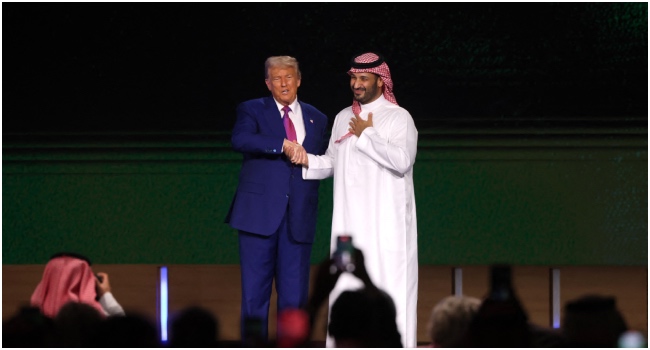
The United States and Saudi Arabia have announced a major agreement to develop a civilian nuclear energy programme in the kingdom, a move expected to strengthen economic ties between both countries but which has also raised concerns over possible nuclear proliferation risks.
The agreement comes at a sensitive time as Washington remains engaged in a conflict with Iran, whose nuclear programme has been a major source of tension in the region and a key issue in stalled diplomatic negotiations.

The deal is expected to create significant opportunities for American companies while providing Saudi Arabia with access to advanced nuclear technology. It is also viewed as a major diplomatic achievement for Riyadh, allowing the kingdom to expand its nuclear ambitions without establishing formal relations with Israel.
In recent years, the United States had pushed for any nuclear cooperation agreement and defence partnership with Saudi Arabia to be linked to normalising relations with Israel.
However, critics have warned that the agreement could encourage a regional nuclear competition, particularly if Saudi Arabia gains the ability to enrich uranium. Reports have suggested that a possible provision could allow American companies to assist in building a uranium enrichment facility in Saudi Arabia, although the U.S. Energy Department did not confirm such details.

Allison Minor, director of the Project for Middle East Integration at the Atlantic Council, said the agreement sends a strong message to Iran while reinforcing Washington’s relationship with Riyadh.
She noted that allowing the possibility of uranium enrichment in Saudi Arabia could influence Iran’s calculations as nuclear negotiations remain stalled.
The agreement will be presented to the U.S. Congress for review, although observers believe lawmakers are unlikely to prevent its implementation due to Republican control of the chamber.
Some American lawmakers and Israeli officials have previously expressed concerns that Saudi Arabia could eventually use nuclear capabilities for military purposes.

Criticism also came from Senator Bernie Sanders, who questioned the decision, arguing that the move appeared inconsistent with Washington’s stated concerns about preventing nuclear enrichment by Iran.
U.S. Secretary of State Marco Rubio defended the agreement, stating that any civilian nuclear cooperation arrangement would include strict safeguards designed to prevent the technology from being diverted into weapons development.
Saudi Arabia has long maintained that it has the right to pursue nuclear energy for peaceful purposes. The kingdom also strengthened its defence ties with nuclear-armed Pakistan last year through a mutual defence agreement.

The United States previously reached a civilian nuclear cooperation deal with the United Arab Emirates in 2009, under which Abu Dhabi does not operate uranium enrichment facilities.
Energy officials in Washington rejected concerns that the Saudi agreement could increase proliferation risks, arguing that it would follow international safety standards and rely on advanced American nuclear technology.
The U.S. currently maintains nuclear cooperation agreements with more than 50 countries, with officials insisting that safeguards and monitoring measures remain central to such partnerships.
However, some experts have urged caution, arguing that allowing Saudi Arabia to develop uranium enrichment capabilities could weaken global efforts to prevent the spread of nuclear weapons.
Matthew Kroenig of the Atlantic Council warned that strengthening relations with Riyadh should not come at the cost of nuclear non-proliferation standards.
Other experts expressed more confidence in the agreement, saying transparency and proper monitoring would be critical to ensuring the programme remains peaceful.
Jennifer T. Gordon of the Atlantic Council’s Nuclear Energy Policy Initiative described the deal as a strategic victory for the United States in its competition with Russia and China, noting that Saudi Arabia was determined to acquire nuclear technology and could have turned to other global powers if Washington had not acted.




