

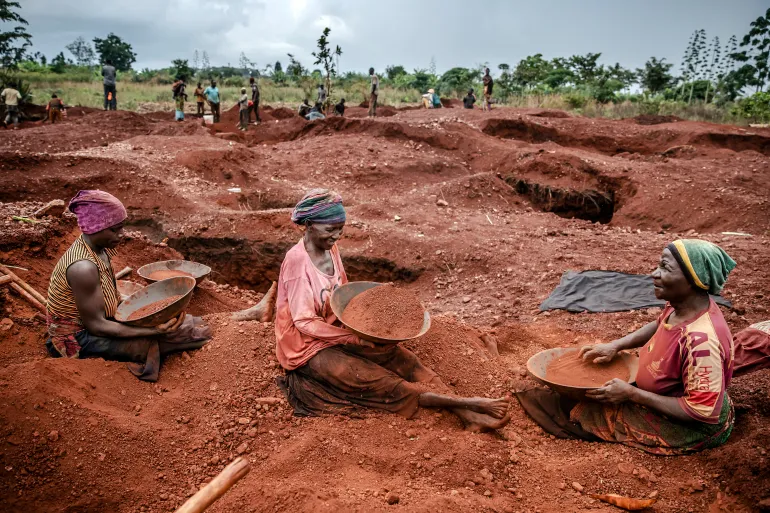
The United States, China and Russia are stepping up efforts to secure access to Africa’s vast mineral resources, intensifying geopolitical competition across the continent and raising questions about how much African countries stand to gain.
From cobalt deposits in the Democratic Republic of the Congo (DRC) to lithium reserves in Mali and uranium resources in Niger, Africa’s mineral wealth is increasingly attracting the attention of major global powers.

While China has established a strong presence in mining, mineral processing and infrastructure, Russia has expanded its influence through military and security partnerships, particularly in the Sahel region.
The United States, meanwhile, is pursuing diplomatic agreements, commercial investments and infrastructure projects to strengthen its access to critical minerals and reduce its dependence on Chinese-controlled supply chains.
The competition is no longer limited to mining operations, as ports, railways and international trade routes have also become important areas of strategic interest.
WHY AFRICA’S MINERALS MATTER TO GLOBAL POWERS
Africa possesses significant reserves of cobalt, lithium, copper and uranium, which are essential to industries such as electric vehicle manufacturing, renewable energy, advanced technology and defence.

For Washington, access to these resources has become a national strategic priority, particularly as concerns grow over China’s dominance of critical mineral supply chains.
In February 2026, US President Donald Trump announced Project Vault, a $12bn initiative designed to establish a strategic stockpile of minerals for American industries.
China, however, has spent years building its position through investments in African mining operations, processing facilities and major infrastructure projects.
Trade between China and Africa reached a record $348bn in 2025, according to Chinese customs figures, reinforcing Beijing’s position as the continent’s largest trading partner.
Russia’s economic presence is comparatively smaller, but Moscow has relied on military cooperation and security agreements to strengthen its relationships with governments seeking alternatives to Western partnerships.

Through its Africa Corps, established in 2023 under Russia’s Ministry of Defence, Moscow has taken over much of the Wagner Group’s former operations across the continent.
Gold has also become an important part of Russia’s economic interests in Africa. A 2024 study by RAND Europe, commissioned by the United Kingdom’s Foreign Office, identified the precious metal as a significant feature of Moscow’s engagement with the continent.
DRC EMERGES AS A MAJOR BATTLEGROUND
The Democratic Republic of the Congo has become one of the most important countries in the competition because of its enormous cobalt reserves.
According to the United States Geological Survey, the DRC accounted for approximately 73 per cent of global mined cobalt production in 2025, making it the world’s largest producer.
Chinese companies already have substantial interests in the country’s mining industry, owning or holding stakes in several major copper and cobalt operations.
China also dominates much of the world’s cobalt refining capacity, giving Beijing considerable influence over the global supply chain.
The United States is seeking to challenge that position through a strategic partnership with Kinshasa.
In December 2025, Washington and the DRC signed an agreement aimed at expanding American access to critical minerals while encouraging investments in infrastructure and mineral processing.
Under the arrangement, the Congolese government is expected to identify strategic mining assets and exploration opportunities, allowing American and eligible partner investors to receive priority consideration for selected projects.

However, the agreement has yet to translate fully into the investments required to develop the sector.
Earlier in November 2026, DRC Economy Minister Daniel Mukoko Samba urged the United States to move beyond diplomatic commitments and deliver concrete investments.
He stressed that the partnership should be assessed through completed projects rather than the number of agreements signed.
The Congolese government wants foreign investment to support local mineral processing, improve electricity access and strengthen the domestic economy instead of leaving the country dependent on exporting unprocessed resources.
TRANSPORT INFRASTRUCTURE BECOMES PART OF THE STRUGGLE
The competition for Africa’s mineral wealth extends beyond ownership of mining sites to the infrastructure required to transport resources to international markets.
China has made infrastructure development a central part of its engagement with African countries through the Belt and Road Initiative, under which several governments have signed cooperation agreements with Beijing.
The United States, working alongside European and African partners, is supporting the Lobito Corridor, a transport network connecting Angola’s Atlantic coast to the copper and cobalt-producing regions of the DRC.
The project also includes plans for a railway extension into Zambia.
The corridor is expected to improve the movement of minerals, reduce transportation costs and strengthen regional trade connections.
For Washington, it represents an opportunity to diversify international supply routes and reduce dependence on infrastructure networks dominated by China.
African countries could also benefit through improved transportation, increased investment and expanded regional commerce.
However, the long-term impact will depend on whether the infrastructure generates opportunities for local industries and communities rather than serving mainly as an export route for foreign companies.

SAHEL REGION ATTRACTS RENEWED INTERNATIONAL ATTENTION
The Sahel has also become an important area of competition, particularly because of its deposits of lithium, gold and uranium.
Mali and Niger possess considerable mineral resources, but political instability, military coups and insecurity have complicated foreign investment.
Following their deteriorating relationships with Western governments, Mali and Niger strengthened their security cooperation with Russia, alongside neighbouring Burkina Faso.
Russia subsequently deployed Africa Corps personnel across parts of the region, strengthening its position as a security partner to the military-led governments.
The United States is now attempting to rebuild diplomatic and economic relationships with countries in the region.

In February 2026, senior US State Department official Nick Checker visited Mali as part of Washington’s efforts to reset relations and reaffirm its respect for the country’s sovereignty.
The renewed diplomatic engagement comes as international companies explore opportunities in the region’s mining industry.
Mali produced an estimated 9,400 tonnes of lithium in 2025, according to the US Geological Survey, placing it among Africa’s leading lithium producers.
Chinese interests are involved in the Goulamina lithium mine, while a subsidiary of Russia’s state-owned nuclear corporation, Rosatom, obtained an exploration licence for the Bougoula lithium project in 2024.
American commercial interests have also explored opportunities in Mali’s gold industry.
In neighbouring Niger, uranium has emerged as another area of renewed American economic interest following the withdrawal of US troops in 2024.
In September 2026, the US International Development Finance Corporation approved financing of up to $414m for the Dasa uranium project, which is being developed by Canadian mining company Global Atomic.
The financing remains subject to certain conditions, including the need to establish a viable transportation route for uranium exports from the landlocked country.
The project highlights Washington’s efforts to restore economic engagement with Niger despite Russia’s continued security presence in the country.
WHAT DOES AFRICA STAND TO GAIN?
The growing rivalry between the United States, China and Russia presents African governments with opportunities to attract foreign investment, diversify international partnerships and negotiate more favourable agreements for their natural resources.
However, the competition also comes with significant risks.
Foreign ownership of mining operations and processing facilities could leave African countries dependent on exporting raw materials without developing the industries needed to capture more value from their resources.

Insecurity, corruption, inadequate infrastructure and weak regulatory institutions could further limit the economic benefits reaching local communities.
For African governments, the challenge is to ensure that international interest translates into sustainable economic development.
This includes creating employment opportunities, expanding domestic mineral processing, improving infrastructure and strengthening local industries.
As Washington, Beijing and Moscow intensify their competition for Africa’s mineral wealth, the central question is no longer simply which global power will secure the greatest influence.
It is whether African countries can use the growing international interest to retain a greater share of the wealth generated from their natural resources.