

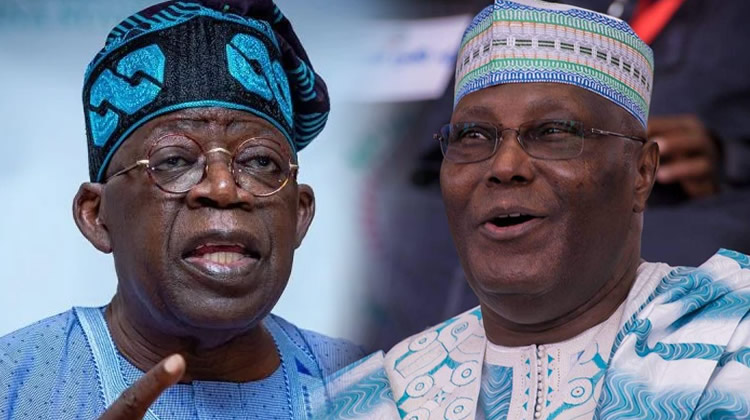
ATIKU’S ANTI-TINUBU CAMPAIGN LACKS THE SOLUTIONS NIGERIANS DEMAND
Nigerians Want Relief, Not Atiku’s Endless War Against Tinubu
By Gloria Fraser, MFR
Former President Olusegun Obasanjo’s description of Atiku Abubakar as a “shameless liar” in My Watch remains one of the most damaging assessments ever made by a Nigerian president of his former deputy. Although Atiku disputes Obasanjo’s account, it raises an unavoidable question: can a candidate carrying such political baggage credibly build another presidential campaign around attacking another man’s integrity?
Nigeria’s next election should be a contest of ideas, competence and measurable solutions—not another exhausting war over certificates and personal histories.

A recent National Patriots survey indicates that Nigerians are more concerned about survival than presidential educational qualifications. The exercise permitted multiple responses, so its percentages represent recurring views rather than mutually exclusive voting blocs. It should be regarded as an indicative opinion survey, not a scientific national poll.
Ninety per cent of respondents said certificates were not their principal concern. They wanted a leader who understood their suffering and could deliver affordable food, employment, security and people-focused governance.
History supports this distinction. Abraham Lincoln had little formal schooling but educated himself before leading the United States through civil war and advancing the abolition of slavery. Brazil’s Luiz Inácio Lula da Silva had vocational training rather than a university degree before becoming president and implementing major poverty-reduction programmes. Poland’s Lech Wałęsa rose from vocational school and the shipyards to lead the Solidarity movement, win the Nobel Peace Prize and become president. Uruguay’s José Mujica had no university degree but earned international respect for his humility and socially focused leadership.

Education matters, but certificates cannot substitute for judgement, empathy, integrity and administrative competence.
At 79, Atiku has a constitutional right to contest, but political longevity is not a manifesto, and attacking President Bola Tinubu is not an economic programme. He must tell Nigerians how he would reduce inflation, create employment, strengthen security, finance his promises and protect vulnerable citizens.
Atiku’s record is itself burdened by controversy. In 2007, a Senate committee accused him of abusing his office in the management of the Petroleum Technology Development Fund and aiding the diversion of $145 million approved for public projects into bank deposits, some allegedly converted into loans for private companies. Atiku denied the allegations and maintained that no PTDF money was missing. A court later struck down the administrative indictment, meaning it did not produce a subsisting conviction. “Reuters” (https://www.reuters.com/article/markets/oil/nigerian-senators-accuse-vp-of-misusing-public-funds-idUSL27364843/), “VOA” (https://www.voanews.com/a/a-13-2006-11-29-voa25/311668.html)
A bipartisan United States Senate investigation subsequently reported that Atiku’s then wife, Jennifer Douglas, helped bring more than $40 million in “suspect funds” into the United States between 2000 and 2008 through offshore corporations. It said $25 million passed through more than 30 American accounts and examined alleged Siemens payments to Douglas, which she denied. The findings raised grave questions, although Atiku was not convicted in the United States. “United States Senate” (https://www.hsgac.senate.gov/subcommittees/investigations/rep/investigations-subcommittee-holds-hearing-on-keeping-foreign-corruption-out-of-the-united-states-four-case-histories/)
The Obasanjo administration’s power-sector expenditure also demands scrutiny. A House committee identified inflated contracts, due-process violations and extensive project failures. It recommended investigations of Obasanjo, ministers, officials and contractors, but did not personally name Atiku.




