
By Princess Gloria Adebajo-Fraser, MFR International Governance Consultant
By all measurable economic standards, no serious nation has ever industrialised without first solving one critical problem: how to move goods, people, energy and capital efficiently.
That was the secret behind America’s rise. It was the foundation of China’s transformation. It was central to Europe’s industrial revolution. Today, President Bola Ahmed Tinubu appears to be placing that same bet on Nigeria’s future.
As President Bola Ahmed Tinubu marks his third year in office, perhaps the most important question confronting Nigerians is not whether every policy has delivered immediate results, but whether the broader vision underpinning those policies is fully understood. Beyond politics and electoral debates, the administration appears focused on rebuilding the foundations of national development through infrastructure, security, economic reform and social protection.
Alongside investments in roads, railways, ports and logistics corridors, the Federal Government has increased fiscal allocations to states to support development projects and social intervention programmes. The administration has also intensified efforts to strengthen national security through defence modernisation, intelligence coordination, international partnerships and institutional reforms, including the appointment of Major General Adeyinka A. Famadewa (Rtd.) as Special Adviser to the President on Homeland Security.
The underlying philosophy appears straightforward: economic prosperity cannot be sustained without infrastructure; infrastructure cannot thrive without security; and reform cannot succeed without measures that protect vulnerable citizens during periods of transition.
While much of Nigeria’s political conversation remains trapped in partisan battles, tribal narratives and social media warfare, a far more consequential development is unfolding beneath the noise: the reconstruction and reconnection of Nigeria’s economic architecture.
History is clear on this matter. Countries do not become prosperous because of speeches. They become prosperous because they build systems that allow commerce to move faster, cheaper and farther. Infrastructure is not cosmetic government activity. Infrastructure is economic power.
Indeed, economists increasingly view infrastructure as the operating system of modern economies. It determines how efficiently goods reach markets, how quickly industries expand, how competitively nations trade and how successfully governments unlock the productive capacity of their citizens.
The United States understood this early. The completion of the Transcontinental Railroad in 1869 fundamentally altered the American economy. Transportation costs fell, agricultural products moved faster, factories gained access to larger markets and entire cities emerged around transport corridors. What initially appeared to be an expensive gamble became the backbone of American capitalism.
China followed a similar path on a much larger scale. Beginning in the 1990s, it embarked on one of the most ambitious infrastructure expansions in modern history, building over 140,000 kilometres of expressways and the world’s largest high-speed rail network. According to World Bank estimates, more than 800 million people were lifted out of poverty during China’s transformation. Infrastructure did not merely support growth; it helped create it.
That is the broader context within which Tinubu’s infrastructure push should be understood. The debate should not simply be whether one likes the President politically. Democracies naturally produce disagreement. The more important question is whether Nigerians fully appreciate the long-term economic implications of what is being built today.
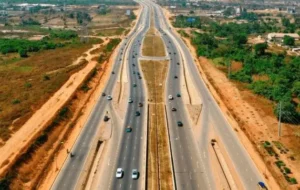
Across Nigeria, multiple transport and logistics corridors are simultaneously under construction, rehabilitation or redesign. The Lagos-Calabar Coastal Highway represents one of the most ambitious infrastructure projects in contemporary Africa. Stretching across several coastal states, it is designed to create a major economic corridor linking ports, tourism zones, industrial clusters and oil-producing regions.
Economists believe the project could reshape trade and investment patterns along Nigeria’s Atlantic coastline while stimulating industrial expansion, real estate growth, hospitality investment and export logistics.
Beyond transportation, the corridor has the potential to stimulate new industrial zones, tourism clusters, export-processing centres and urban development projects capable of reshaping economic activity along Nigeria’s coastline for generations.
Critics initially dismissed the project as unrealistic. Yet history shows that transformational infrastructure projects often appear excessive in their early stages. America’s rail expansion was once attacked as financially reckless, while China’s early expressways were mocked because many roads initially appeared empty. Today, those same projects underpin two of the world’s largest economies.
The Sokoto-Badagry Super Highway is another strategic undertaking with implications far beyond transportation. By linking parts of the North-West to the South-West commercial axis, the project aims to reduce freight bottlenecks, strengthen agricultural supply chains and improve interregional commerce.
In practical terms, food produced in northern Nigeria could eventually reach southern markets faster and at lower cost. Reduced logistics expenses can lower inflationary pressures, improve profitability for farmers and businesses and strengthen national market integration. In a country where transportation inefficiencies significantly increase business costs, such improvements carry enormous economic significance.
This also explains the importance of projects such as the Abuja-Kaduna-Zaria-Kano Road and the Akwanga-Jos-Bauchi-Gombe-Maiduguri corridor. These are not ordinary roads. They are economic arteries linking agricultural zones, commercial centres and industrial markets.

Northern Nigeria remains one of Africa’s largest agricultural belts, while southern Nigeria contains major ports, financial centres and industrial clusters. A poorly connected country cannot maximise either advantage.
The Bodo-Bonny Road in the Niger Delta carries similar strategic value. It improves access to oil and gas infrastructure while supporting commercial activity in one of Nigeria’s most resource-rich regions. At the same time, evacuation corridors connected to the Lekki Deep Sea Port and the Dangote Refinery are intended to support industrial-scale distribution networks.
The Dangote Refinery, with projected refining capacity of 650,000 barrels per day, is one of Africa’s largest industrial investments. Yet even projects of that scale require efficient transport systems to reach their full economic potential.
Factories do not create prosperity in isolation. They require roads, ports, rail systems and energy corridors to function efficiently. That is why the rail dimension of Tinubu’s infrastructure strategy may ultimately prove even more transformative.
Globally, every major industrial economy eventually integrated rail into its growth strategy because rail remains one of the most efficient methods of moving large volumes of cargo over long distances. In China, rail connectivity became central to manufacturing expansion. In the United States, rail transformed internal commerce and accelerated industrialisation. Across Europe, integrated rail systems strengthened regional trade and productivity.
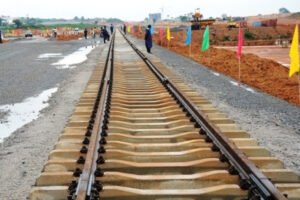
Nigeria’s renewed rail ambitions, including Lagos, Kaduna, Kano and proposed eastern corridor connections such as Calabar-Maiduguri, suggest an effort to reposition the country toward integrated logistics planning. Efficient freight rail systems can reduce pressure on highways, lower transportation costs, improve food distribution and enhance national competitiveness.
Infrastructure directly influences investment, trade efficiency, productivity and market expansion. Nigeria’s challenge has never been a lack of population or natural resources. Rather, it has been the weak integration of economic potential. Large parts of the country produce wealth but remain disconnected from markets, processing centres, export facilities and industrial corridors. Infrastructure changes that equation.
Trillions of naira have been committed to road projects nationwide alongside investments in bridges, ports, rail modernisation and urban transport systems. This does not mean every project will be executed flawlessly. Concerns regarding debt sustainability, transparency, environmental impact and project continuity remain legitimate and deserve scrutiny. Such accountability is healthy in a democracy.
However, history also shows that nations rarely become globally competitive by avoiding ambitious infrastructure investments altogether.
One weakness in Nigeria’s political discourse is the tendency to judge infrastructure primarily through immediate inconvenience rather than long-term economic restructuring. Road construction disrupts traffic. Rail projects require significant financing. Coastal highways generate environmental concerns. These are real issues.
Yet infrastructure also creates powerful multiplier effects. Construction generates jobs. Improved roads reduce transport time. Faster logistics improve trade efficiency. Investors prefer regions with reliable transport networks. Property values rise around transport corridors. Industrial activity expands beyond congested urban centres. That is how nations scale economically.
Nigeria may still be years away from fully realising the benefits of these projects. Infrastructure transformation is rarely immediate. America’s rail revolution unfolded over decades. China’s expressway expansion took years before producing visible nationwide prosperity.
But the strategic direction matters.
What is emerging under Tinubu increasingly resembles an attempt to redesign Nigeria’s economic map around connectivity, logistics and mobility. Whether one supports or opposes the President politically, the infrastructure dimension of the current administration deserves serious analytical attention rather than reflexive dismissal through partisan or tribal lenses.
The true measure of this strategy will not be found in political debates but in whether these investments ultimately reduce logistics costs, improve productivity, attract investment, create jobs and raise living standards for ordinary Nigerians.
History often rewards countries that build before they become rich, not after. And perhaps that is the real story unfolding beneath Nigeria’s noisy political atmosphere: not merely roads and railways, but the foundations of a different economic architecture capable of reconnecting markets, lowering costs, attracting capital and unlocking productivity on a national scale.
If sustained across multiple administrations, it could become one of the most consequential infrastructure transitions Nigeria has witnessed in decades.
In the end, history rarely remembers the loudest political arguments. It remembers the countries that built.
Princess Gloria Adebajo-Fraser, MFR President, National Patriots Movement of Nigeria