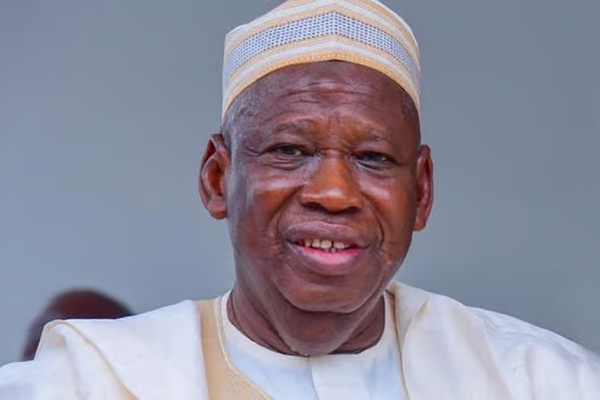
Former governor and immediate-past National Chairman of the ruling All Progressives Congress (APC), Dr. Abdullahi Umar Ganduje, has called on state governors, development partners, and philanthropists to scale up investments in Persons with Disabilities (PWDs) as a strategic move to eradicate street begging in Northern Nigeria.

He spoke on Friday in Abuja during the 10th-anniversary documentary premiere of a Kano State based organisation dedicated to the educational needs of the deaf and blind – “Let’s Talk Humanity (LTH) Initiative.”
Ganduje, who is now board Chairman of the Federal Airport Authority of Nigeria (FAAN), lamented the systemic neglect of the disabled, which has fueled a visible crisis of homelessness and panhandling.
He highlighted that the current state of disability in Northern Nigeria is a “sorry story” that requires “silent revolution” and urgent intervention through technology and specialised education.
“In the northern part of this country, people with disabilities are so much relegated to the background. That’s why we have an array of beggars across the North day and night. Some sleep under bridges, some sleep on
He however noted that witnessing the success recorded in the last 10 years of the LTH initiative offered a blueprint for change.

“You can see that there is a silent revolution. If what we have seen could be adopted by our executive governors and philanthropists, there’s no doubt there will be a big change in our society.”
Stressing the need to restore the human dignity of the physically challenged, the former governor noted that years of neglect has a profound psychological impact on them, often stripping them of their sense of self-worth.
He then urged leaders to move beyond charity and toward empowerment: “I urge those in authority to make a great change. They can develop to the extent that they can even be employers of labour. They can be geniuses in various fields of endeavors.”
Minister of Humanitarian Affairs and Disaster Management, Dr. Bernard M. Doro, argued that the inclusion of people with special needs is a fundamental obligation of the state.
The Minister called for a shift in how technology and infrastructure are developed, insisting that accessibility should not be an afterthought.
“We must move towards a future where accessibility is by design, moving away from retrofitting tools towards building universal platforms. You don’t wait until you [build something] before you begin to adapt it for people to use,” the Minister remarked.
The founder of Let’s Talk Humanity Initiative, Mrs. Fatima Ganduje Abiola-Ajumobi, who described the 10 years of the initiative as a “decade of impact”, revealed that her organisation has empowered approximately 1,000 beneficiaries annually since its inception in 2015.
Reflecting on a decade of service to the Tudun Maliki Special School in Kano, she shared an ambitious vision for the future:
“Our projection for the next 10 years is to establish a National Resource Center for those with sensory impairment. We want to tap into international knowledge and resources to bring special needs education in Nigeria up to global standards.”

The event featured a keynote speech by Ibrahim Abdukabir, Vice Principal of Tudun Maliki Special School, and brought together a diverse group of experts, government officials, and alumni who have benefited from the initiative’s focus on technological integration in disability education.