


Strategic Realignment: Optimising Experience Without Undermining Emerging Leadership in Kano.
Within this context, a more pragmatic pathway exists—one that preserves party unity while maximising the strengths of all key actors.
The re-entry of Ibrahim Shekarau into APC need not translate into direct competition in the Kano Central senatorial race. Rather, it presents an opportunity for strategic redeployment of experience at a level where it can deliver broader national and regional value.

Given Kano’s long-standing position as one of Nigeria’s most agriculturally significant states—contributing substantially to food production, livestock, and agro-trade—there is a compelling case for Shekarau’s experience to be channelled into federal executive responsibility, particularly within sectors such as agriculture, rural development, or allied economic portfolios.
A ministerial role would not only align with his profile as a former governor but would also place him in a position to influence policy, attract federal resources, and drive large-scale interventions that directly benefit Kano and the wider North-West.
This approach reflects a well-established governance principle: leadership is most effective when deployed where it delivers the greatest impact—not merely where it sustains political visibility.
For APC, such a recalibration offers a dual advantage.
First, it preserves internal cohesion by recognising Shekarau’s stature and experience at an appropriate level of national responsibility.
Second, it clears the path for generational transition within the legislative space—particularly in constituencies like Kano Central, where voter expectations are rapidly evolving.

The Senate, by its very nature, benefits from representation that is deeply embedded within current grassroots realities—leaders who are actively engaged, accessible, and in continuous touch with the socio-economic pressures facing their constituents.
This is where Dr. Mohammed Musa Zango’s candidacy becomes strategically compelling.
His sustained presence at the community level, built over two decades of direct intervention, places him in closer alignment with contemporary voter expectations. His support base is not speculative—it is organic, built on trust, familiarity, and consistent engagement.
In political terms, this is what translates to electoral efficiency: lower resistance, higher mobilisation potential, and stronger voter turnout alignment.
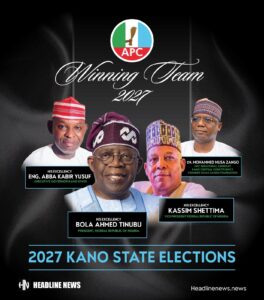
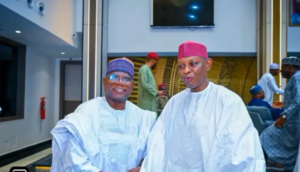
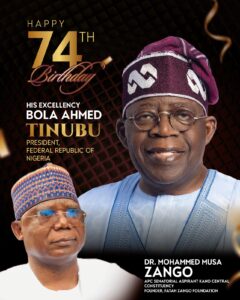
Reports from within Kano Central already point to a growing consolidation of support around Dr. Zango, reflecting a constituency increasingly inclined toward leadership that is visible, responsive, and service-driven.
For party decision-makers, the implication is straightforward.
Balancing experience with renewal is not a zero-sum game. It is a strategic necessity.
Positioning Shekarau within the federal executive framework while allowing a new-generation candidate like Dr. Zango to carry the party’s senatorial flag achieves both continuity and progression.
It also sends a powerful signal—that APC is not merely a platform for political recycling, but a party capable of recognising when to transition, when to renew, and when to elevate those whose legitimacy is grounded in present-day impact.
The National Patriots Movement supports a strategic balance that preserves experience while advancing credible new leadership. The redeployment of Ibrahim Shekarau to a federal ministerial role offers broader value, while creating space for Dr. Mohammed Musa Zango—whose two decades of grassroots humanitarian service reflect true democratic dividends—to represent Kano Central. This is not a contest of personalities, but a decision about impact, relevance and the future of representation. APC must align with evolving voter expectations by rewarding proven service, public trust and measurable connection to the people.
Princess G. Fraser. MFR
President, the National Patriots





InshaAllahu you stand tall judging from your credentials, easy access to reach you ,your humanitarian gesture, your concerns about kano central development and ready to give dividend of the Democracy to grassroots in the constituency. We cannot continue to recycle