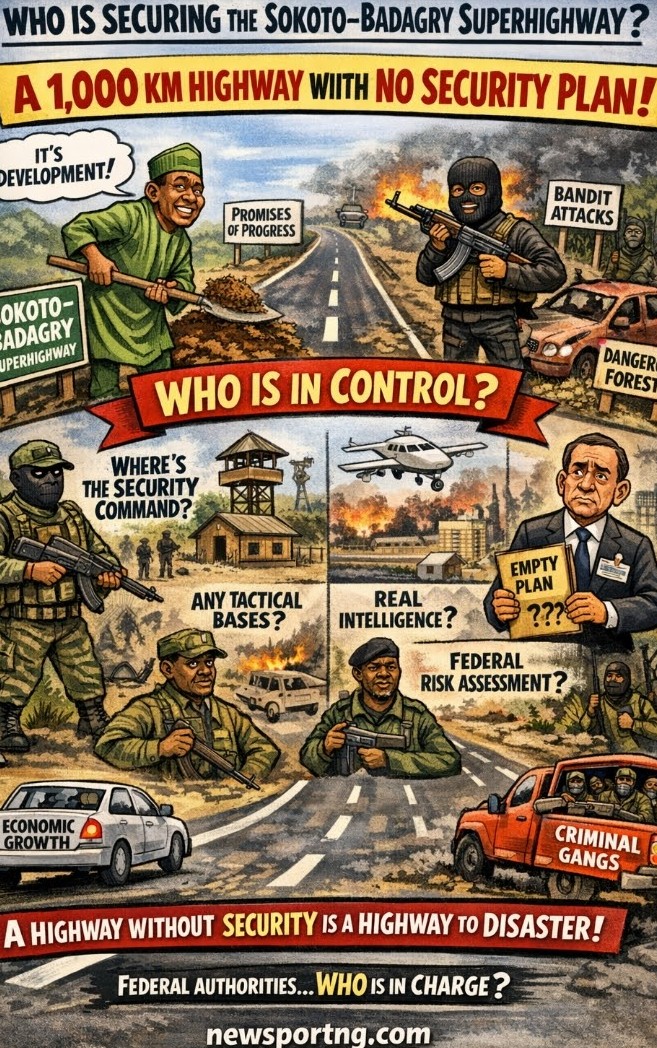
Nigeria is building roads into danger and calling it development.
The Sokoto–Badagry Superhighway is being presented as a national economic artery. But beneath the language of progress sits a far more uncomfortable reality: Nigeria is expanding physical connectivity faster than it is strengthening security control.
And that imbalance is no longer theoretical. It is already being tested in blood, ransom payments, abandoned farms, and displaced communities.
So the real question is not whether this project is good for trade.
The question is far more direct:

Who is securing a 1,000-kilometre strategic corridor that passes through zones already experiencing armed activity, porous borders, and forest-based criminal networks?
Because right now, there is no convincing public answer.
A HIGHWAY WITHOUT A SECURITY DOCTRINE IS NOT AN ASSET. IT IS A VULNERABILITY
Let’s be clear.
You cannot carve a national superhighway through:
North-West insecurity corridors,

North-Central spillover zones,
forest-linked transit routes,
and expanding South-West rural border belts,
and then treat security as a side conversation handled by “relevant agencies.”
That approach is not governance.
It is negligence dressed in infrastructure language.
So the questions that must be asked without diplomatic cushioning are these:
Where is the dedicated security command structure for this corridor?
Who is in charge of real-time intelligence fusion along this route?
What is the inter-state operational framework between Sokoto, Kebbi, Niger, Kwara, Oyo, Ogun, and Lagos?
How many permanent tactical bases are being deployed before full operation begins?
What surveillance system exists beyond predictable checkpoints that criminal networks already understand how to bypass?
If these answers are vague, then everything else is political theatre.
STOP PRETENDING THE THREAT IS CONTAINED IN ONE REGION
There is a dangerous comfort in Nigeria’s security discourse:
Northern crisis is spoken of as northern problem.
Southern calm is mistaken for immunity.
That illusion is collapsing.
What is unfolding is not regional insecurity. It is networked mobility-driven violence.
Criminal actors no longer respect geography. They follow:
road expansion,
forest cover,
weak enforcement zones,
and predictable state response patterns.

And here is the uncomfortable truth:
Every new highway without embedded security architecture becomes a ready-made corridor for whoever understands how Nigeria’s enforcement gaps operate.
So when southern states assume “it is not our problem yet,” the question becomes:
At what point does “yet” become too late?
WHERE IS THE FEDERAL RISK ASSESSMENT?
Before committing over half a billion dollars and opening up a strategic national corridor, Nigerians deserve more than assurances.
Where is the publicly available:
security impact assessment,
threat modelling report,
corridor vulnerability map,
and inter-agency operational blueprint?
Because what is visible today is a pattern: announcement first, security planning later, crisis response eventually.
That is not strategy. That is exposure by design.
And exposure is exactly what violent networks exploit.
SOUTHERN STATES: THE COMFORT ZONE IS OVER
Let this be stated without ambiguity:
South-West, South-East, and South-South governments can no longer behave as though insecurity is geographically distant.
It is already creeping into their peripheries:
rural kidnappings along inter-state routes,
forest-based criminal shelters,
expanding highway vulnerability zones,
and weak intelligence coordination across borders.
So the question to governors is simple and unavoidable:
What independent, functional security architecture exists in your state beyond overstretched federal policing structures?
Because waiting for Abuja alone is not strategy. It is dependency.
And dependency in a decentralised threat environment is a liability.
THE HARD REALITY
Nigeria is attempting to build a modern transport superhighway on top of a fragmented and overstretched security system.
That combination produces only two outcomes:

accelerated economic movement, or
accelerated criminal mobility
The difference is not the road.
The difference is whether the state has built enforcement capacity equal to its infrastructure ambition.
Right now, that balance is not visible.
And pretending otherwise is how states lose control of strategic corridors without formally admitting it.
FINAL QUESTION
So before the first full stretch of this highway becomes operational and before the political speeches are concluded, there is only one question that demands an answer from the federal government:Politics
Who, specifically, is responsible for ensuring that the Sokoto–Badagry Superhighway does not become a permanent transit corridor for armed groups, criminal networks, and insecurity spillover across the Nigerian federation?