

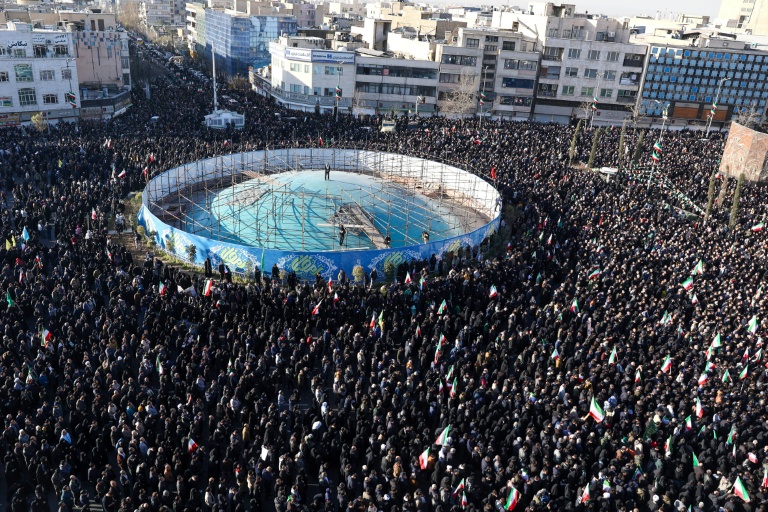
The United States announced on Sunday that it had destroyed the headquarters of Iran’s elite Islamic Revolutionary Guard Corps (IRGC), marking a major escalation in the ongoing conflict. However, Washington also confirmed its first military casualties since the campaign began.

United States Central Command (CENTCOM) disclosed the strike in a statement shared online, accompanied by footage showing missiles launched from a US Navy vessel hitting what it described as the IRGC’s headquarters in Tehran. The command declared that the powerful Iranian force “no longer has a headquarters.”
As airstrikes continued in the Iranian capital, President Donald Trump indicated that the war could last up to four weeks, describing it as a limited but decisive operation.

The joint US-Israeli offensive reportedly began with bombardments that killed Iran’s Supreme Leader, Ali Khamenei. In response, Iran launched missiles and drones targeting locations across the Middle East, with blasts reported in several Gulf countries as well as Israel.
The Pentagon confirmed that three American service members were killed in action, while five others sustained serious injuries. Additional troops reportedly suffered minor wounds. Officials stated that major combat operations remain ongoing.

Iran’s retaliation intensifies
Iran’s Revolutionary Guards announced what they described as a large-scale counterattack, firing missiles and deploying drones at installations across the Gulf region.
An attack on Beit Shemesh in central Israel left at least nine people dead, according to authorities. Senior Iranian official Ali Larijani vowed unprecedented retaliation, while Iran’s President, Masoud Pezeshkian, labeled Khamenei’s killing a declaration of war and pledged to hold those responsible accountable.
Israeli Prime Minister Benjamin Netanyahu said operations against Iran would intensify in the coming days. The Israeli military announced the mobilization of around 100,000 reservists as part of heightened readiness.

Gulf states drawn into the conflict
The confrontation has spilled across the Gulf region. Drone strikes reportedly hit Oman’s commercial port of Duqm, injuring a foreign worker. Maritime security agencies also reported attacks on vessels in the Strait of Hormuz, a vital global shipping route.
Iran claimed to have targeted the aircraft carrier USS Abraham Lincoln, but US officials dismissed the assertion, stating that the missiles did not come close. President Trump, meanwhile, said US forces had sunk several Iranian naval vessels and damaged key military infrastructure.
Several Gulf nations reported casualties and damage from retaliatory strikes. The United Arab Emirates confirmed fatalities and announced it was withdrawing its ambassador from Iran while closing its embassy.

Inside Iran, the humanitarian toll has mounted. The Iranian Red Crescent reported hundreds of casualties following the strikes. Among those confirmed dead were senior officials, including top adviser Ali Shamkhani and IRGC commander Mohammad Pakpour.
Uncertainty over succession
Following confirmation of Khamenei’s death, Iran appointed Alireza Arafi to join an interim leadership council alongside President Pezeshkian while the country prepares to select a permanent successor.
Reactions within Iran have been mixed. While some citizens reportedly celebrated, others expressed fear and uncertainty about the nation’s future amid intensifying hostilities.
With both sides signaling further escalation, the region remains on edge as the conflict threatens broader instability across the Middle East.




