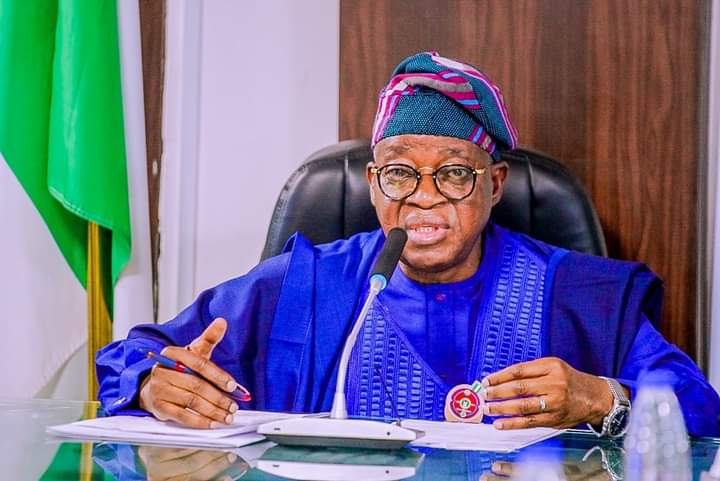
Oyetola: Nigeria Approves New Deep Seaports to Boost Trade and Maritime Growth
The Minister of Marine and Blue Economy, Adegboyega Oyetola, says the Federal Government has approved the development of additional deep seaports across Nigeria as part of efforts to strengthen the country’s maritime infrastructure and position it as a major logistics hub in West and Central Africa.
Oyetola made the disclosure on Monday in Lagos while declaring open the mid-year session of the Board of Directors of the Port Management Association of West and Central Africa (PMAWCA).
The event, themed “Ports of the Future: Combining Logistical Resilience with Inclusive Community Development,” brought together maritime stakeholders and industry leaders from across the sub-region.

New ports to boost capacity and trade
According to the minister, the new deep seaports will complement existing facilities, improve efficiency, and strengthen Nigeria’s competitiveness in regional and international trade.
“Approvals have therefore been granted for the development of additional deep seaports across the country to complement existing infrastructure, strengthen supply chain resilience, and reinforce Nigeria’s position as the preferred maritime and logistics hub for West and Central Africa,” Oyetola said.
He added that ongoing reforms under President Bola Tinubu’s administration are also focused on upgrading existing ports through modern infrastructure, digital systems, and channel deepening to allow larger vessels to dock more efficiently.
Improved efficiency at Nigerian ports
Oyetola noted that coordinated reforms and improved collaboration among government agencies have already started yielding positive results at the nation’s ports.
He said cargo evacuation has become faster, vessel waiting times have reduced, and overall operations are now more predictable for businesses and investors.
“These efforts have contributed to improved cargo evacuation, reduced vessel waiting time, greater operational efficiency, and a more predictable business environment for port users and investors,” he said.

The minister also highlighted the National Single Window project as a key reform initiative aimed at simplifying cargo clearance by integrating port operations with relevant government agencies through digital platforms.
Maritime security gains
On security, Oyetola said the Deep Blue Project has played a major role in eliminating piracy in Nigerian waters and significantly reducing maritime crimes across the Gulf of Guinea.
$27bn worth of port projects underway
Earlier, the Managing Director of the Nigerian Ports Authority (NPA) and President of PMAWCA, Abubakar Dantsoho, revealed that over $27 billion worth of port-related investments are currently ongoing or have recently been announced across West and Central Africa.
He listed major projects including the $20 billion Simandou-Morebaya deep seaport in Guinea, the $2 billion Port San Pedro project in Côte d’Ivoire, the $1.5 billion Lekki Deep Sea Port in Lagos, and a proposed $600 million investment by APM Terminals in Nigeria.
Dantsoho said ports in the region must evolve beyond cargo handling and become key drivers of the wider blue economy, supporting long-term economic growth and regional integration.