

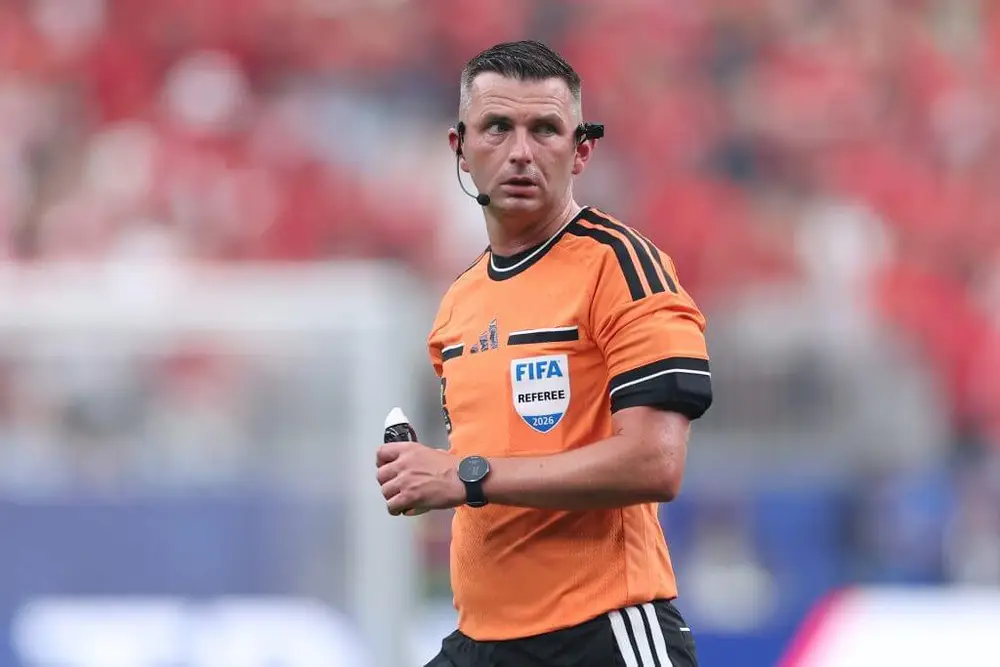
English referee Michael Oliver is set to officiate his seventh FIFA World Cup match when Spain face Belgium in Thursday’s quarter-final in Los Angeles, making him the English official with the most World Cup appointments.
Despite the achievement, Oliver’s chances of handling the World Cup final on July 19 remain unlikely because of FIFA’s referee selection rules.

Under FIFA regulations, match officials are not assigned to games involving their own countries to ensure neutrality. In addition, English referees, including Oliver and Anthony Taylor, are not appointed to Argentina matches due to the long-standing political sensitivities surrounding the 1982 Falklands War between the United Kingdom and Argentina.
The conflict, which lasted 74 days, continues to influence referee appointments at international tournaments, with FIFA taking geopolitical considerations into account when selecting match officials.
As a result, Oliver or Taylor can only be considered for the World Cup final if neither England nor Argentina qualifies for the tournament’s showpiece match.

A similar situation occurred during the 2022 World Cup in Qatar when Anthony Taylor, despite being regarded as one of the tournament’s top-performing referees, was ruled out of officiating the final after Argentina secured a place in the championship match.
FIFA determines referee appointments on a match-by-match basis, with officials’ performances serving as the primary criterion. However, political and geopolitical factors are also considered where necessary to avoid any perception of bias.
The same principle applies to other international rivalries, meaning referees may also be excluded from fixtures involving countries with sensitive diplomatic or political relationships.

FIFA also prevents referees from handling matches that could directly affect their own national teams’ progress in the competition. Similarly, in domestic football, officials are restricted from officiating games involving clubs with which they have personal or regional affiliations.
Former Italian referee Pierluigi Collina, who serves as FIFA’s chief refereeing officer, has the final responsibility for deciding referee appointments throughout the tournament.

Meanwhile, former Premier League referee Graham Scott has questioned the continued application of restrictions linked to historical conflicts, arguing that elite referees are trained to remain impartial and should be judged on their professionalism rather than political history.




