

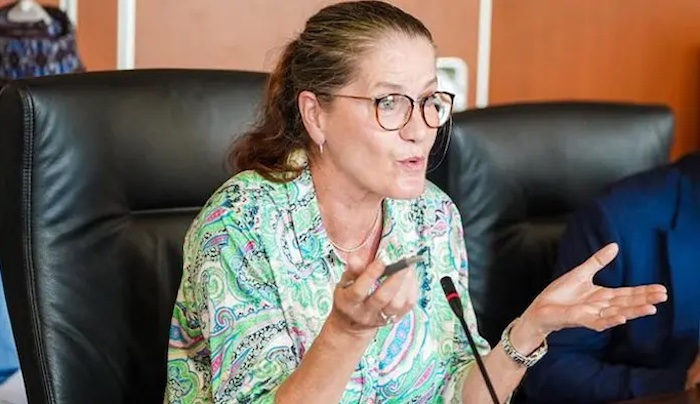
Germany’s Ambassador to Nigeria and ECOWAS, Annett Günther, has revealed that Nigeria lost an estimated $1.5 billion in 2024 due to gas flaring after burning approximately 5.3 billion cubic metres of associated gas, making the country the seventh-largest gas flaring nation in the world.
She made the disclosure during a fireside discussion at the 25th Nigeria Oil and Gas (NOG) Energy Week in Abuja, where stakeholders gathered to discuss strategies for advancing sustainable and competitive energy systems.

According to Günther, Germany has launched a new initiative aimed at converting gas that is currently flared into valuable energy resources for households, industries and future hydrogen production.
She explained that the programme forms part of the long-standing energy partnership between Nigeria and Germany, which has evolved over nearly two decades and was further strengthened by the signing of the Joint Declaration of Intent on Bilateral Energy Transition Dialogue in 2025.
The ambassador noted that reducing gas flaring would not only lower greenhouse gas emissions but also unlock significant economic opportunities by supplying gas to homes, industries and emerging hydrogen projects.

Günther recalled that both countries established the German-Nigerian Energy Partnership in 2008, followed by the creation of an energy desk at the German-Nigerian Chamber of Commerce in 2012 and the launch of the Nigerian Energy Support Programme (NESP) in 2013.
She said the NESP, implemented by GIZ, has continued for more than a decade and is currently in its sixth phase.
She also highlighted the establishment of the German-Nigerian Hydrogen Office in 2021 to explore opportunities in low-carbon hydrogen development, adding that the bilateral partnership reached another milestone in 2025 with the signing of the energy transition cooperation agreement.

According to the ambassador, Germany remains committed to supporting Nigeria’s energy transition agenda while promoting cleaner energy solutions and addressing climate-related challenges associated with oil and gas production.
She identified low-carbon energy development, including renewable energy, hydrogen production and natural gas infrastructure, as one of the key priorities of the partnership.
Günther noted that while Nigeria is targeting net-zero carbon emissions by 2060, Germany aims to achieve the same goal by 2045, creating opportunities for both countries to collaborate on cleaner energy technologies.

She added that recent global geopolitical developments have highlighted the importance of diversifying energy sources, making cooperation between both countries increasingly strategic.
The ambassador also identified skills development and increased private sector participation as another major area of collaboration, noting that Germany is working with organisations such as GIZ, Siemens Energy and the European Union to strengthen Nigeria’s energy sector.
She explained that the newly introduced flare gas commercialisation initiative will explore technical, regulatory and financing solutions that will enable gas currently being wasted through flaring to be captured and utilised for electricity generation, industrial production and hydrogen development, while also creating new revenue opportunities for Nigeria.




