

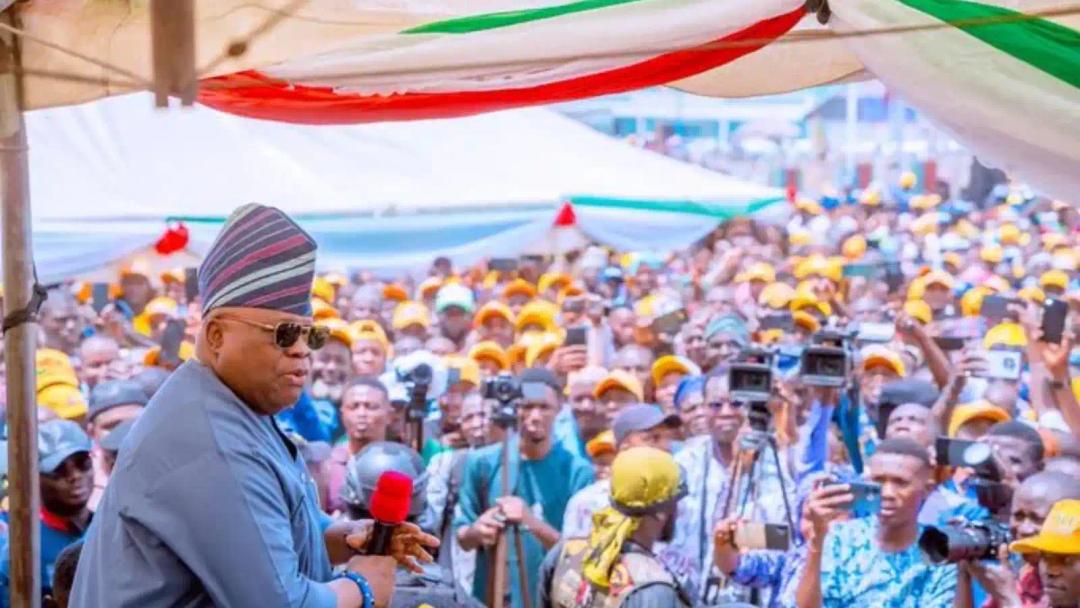
Barely hours after securing a second term as Osun State governor, Ademola Adeleke has triggered a fresh political debate following his renewed endorsement of President Bola Ahmed Tinubu for the 2027 presidential election.
Adeleke, who contested the August 15 governorship election on the platform of the Accord Party, defeated the All Progressives Congress (APC) candidate, Bola Oyebamiji, to retain his seat.
Shortly after his victory was announced by the Independent National Electoral Commission (INEC), Adeleke thanked President Tinubu for congratulating him and praised the President for what he described as his support for a free and fair election.
He also reaffirmed his previous decision to support Tinubu’s bid for a second term in 2027, describing the President as a son of Osun State.
“Mr President is a son of Osun State, and I hereby reaffirm my earlier endorsement of him for a second term in the 2027 presidential election,” Adeleke said.
The governor later explained that his endorsement was not based on any political agreement with Tinubu.

Asked whether he had reached a deal with the President, Adeleke replied: “No, I never reached an agreement with Mr President.”
He said his decision was influenced by Tinubu’s Yoruba and South-West roots, as well as his desire to see federal projects in the region continued.
According to Adeleke, the President should be given another opportunity to continue his reforms and complete ongoing projects, particularly federal road projects across the South-West.
When asked if he would actively campaign for Tinubu in 2027, Adeleke responded: “Big time, I will.”
Mixed reactions from supporters
The endorsement has generated divided reactions, particularly among some of Adeleke’s supporters and opposition figures who had backed his campaign against the APC during the Osun election.
Some critics accused the governor of prioritising ethnic considerations over competence, while others questioned why he credited Tinubu for the conduct of the election.
One critic argued that voters had defended Adeleke’s mandate during the election only for him to immediately endorse the President whose party he had just defeated.
Another questioned Adeleke’s description of the election as free and fair, arguing that the conduct of elections falls primarily under the responsibility of INEC.
Some commentators, however, cautioned against assuming that Adeleke’s endorsement would automatically translate into votes for Tinubu in Osun State.
They maintained that while the governor has the right to support any presidential candidate, the ultimate decision would remain with individual voters and their Permanent Voter Cards (PVCs).
Political calculation?
Beyond the criticism, some observers interpreted Adeleke’s position as a strategic move to maintain a cordial relationship with the Federal Government.
One commentator suggested that the governor could be positioning himself carefully ahead of possible legal challenges to the Osun election result, noting that maintaining a working relationship with the President could prove politically useful if the election enters a prolonged legal battle.
Others argued that Adeleke’s endorsement should be viewed within the broader political realignment already taking shape ahead of the 2027 general elections.
Adeleke’s Osun victory
Adeleke won the Osun governorship election with 511,067 votes, defeating APC candidate Bola Oyebamiji, who polled 444,815 votes. African Democratic Congress (ADC) candidate Najeem Salaam finished third with 17,180 votes.
The governor won 19 of the state’s 30 local government areas, while Oyebamiji secured 11.
The victory gives Adeleke another four-year term after he was first elected governor in 2022 under the Peoples Democratic Party (PDP).
However, his latest endorsement of Tinubu has created an unusual political dynamic: Adeleke has just defeated Tinubu’s APC in a fiercely contested state election while simultaneously declaring his intention to campaign for the President’s re-election in 2027.
The development is likely to remain a major talking point as political alignments ahead of the 2027 general elections continue to take shape.




