

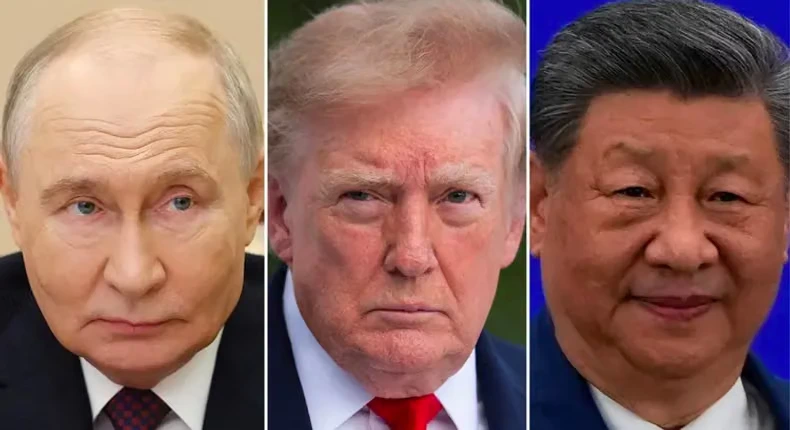
Russia has effectively abandoned its efforts to replace the US dollar with China’s yuan in international trade, following mounting difficulties caused by American sanctions on financial institutions dealing with Moscow.
The development represents a major setback for President Vladimir Putin’s years-long campaign to reduce Russia’s dependence on the US dollar and promote alternative currencies through the BRICS economic bloc.

According to a report by Bloomberg, cited by Business Insider Africa, the Chinese yuan’s share of payments for Russian exports has fallen significantly, dropping by half from its peak in mid-2024 to 22 per cent in 2026.
Meanwhile, Russia now receives 69 per cent of its export payments from Asian countries in its own currency, the rouble, indicating a growing shift away from the yuan.
HOW US SANCTIONS DISRUPTED RUSSIA’S PLANS
Russia accelerated its move towards the Chinese yuan after invading Ukraine in February 2022, when Western sanctions restricted Moscow’s access to major international financial systems.

By 2024, the yuan accounted for nearly half of Russia’s foreign trade settlements. It also became the most traded currency on the Moscow Exchange, overtaking the US dollar in Russian bank deposits.
Putin had repeatedly criticised Washington’s influence over the international financial system, accusing the United States of using the dollar as a political weapon.
Speaking at the BRICS summit in Kazan in October 2024, the Russian president said the dollar was being used as an instrument of political pressure and warned that such an approach could weaken confidence in the American currency.
However, Russia’s growing reliance on the yuan encountered fresh difficulties after Washington expanded its secondary sanctions on 12 June 2024.

The measures targeted foreign financial institutions conducting certain transactions with sanctioned Russian entities, exposing banks to the risk of losing access to the US financial system.
Chinese banks subsequently became more cautious about processing payments involving Russian businesses, fearing possible American penalties.
The restrictions also affected Russia’s Moscow Exchange, which was sanctioned by Washington and forced to suspend dollar and euro trading.
RUSSIAN BUSINESSES TURN TO ALTERNATIVE PAYMENT CHANNELS
As major Chinese banks restricted transactions with Russian institutions, businesses in Russia increasingly turned to smaller regional Chinese banks and financial intermediaries to complete payments.

However, these alternative arrangements have created additional costs and complications.
According to Russian newspaper Kommersant, transport company STT Logistics estimates that alternative payment arrangements can cost businesses as much as 20 per cent of the transaction amount.
Sergei Ishkov, a partner at consulting firm MCK Partners, explained that Chinese banks risked losing their American correspondent banking relationships if they continued processing payments for sanctioned Russian institutions.
Despite these challenges, some Russian companies say they have continued making yuan payments without significant difficulties.
Alexey Kuchmin, chief executive of AIR Group, told Kommersant that he had not experienced major problems with yuan transactions.

CHINA’S YUAN STRUGGLES TO CHALLENGE THE DOLLAR GLOBALLY
Despite its expanding economic relationship with Russia, China has yet to establish the yuan as a major alternative to the US dollar in international transactions.
China remains Russia’s largest trading partner, accounting for more than a third of the country’s foreign trade turnover.
However, the yuan’s position in global financial transactions remains relatively small.
According to figures cited in the report, the currency accounted for less than three per cent of global trade settlements in the third quarter of 2025.
SWIFT data cited by Kommersant also indicated that the yuan had fallen from fourth to fifth place in global payments, behind the Japanese yen.

Chinese President Xi Jinping has continued efforts to expand the international use of the yuan. However, Beijing’s capital controls and cautious approach to opening its financial system have limited the currency’s wider international adoption.
BRICS’ PUSH FOR AN ALTERNATIVE TO THE DOLLAR
Russia’s latest setback also raises questions about the broader BRICS campaign to reduce dependence on the US dollar.
The bloc, which includes Brazil, Russia, India, China and South Africa, has increasingly discussed alternative payment systems and the use of national currencies in international trade.

The group has since expanded to include countries such as Egypt, Ethiopia, Iran and the United Arab Emirates, while Nigeria and Uganda have joined as partner countries.
Although some members support reducing reliance on the dollar, there is no unified agreement to replace it with a single alternative currency.
Russia’s experience highlights the challenges involved in reducing dependence on the dollar, particularly when international financial institutions remain concerned about the consequences of American sanctions.
For Moscow, the shift towards the rouble represents a significant change in its strategy, as its attempt to rely more heavily on China’s yuan has encountered obstacles despite growing trade relations between the two countries.




