

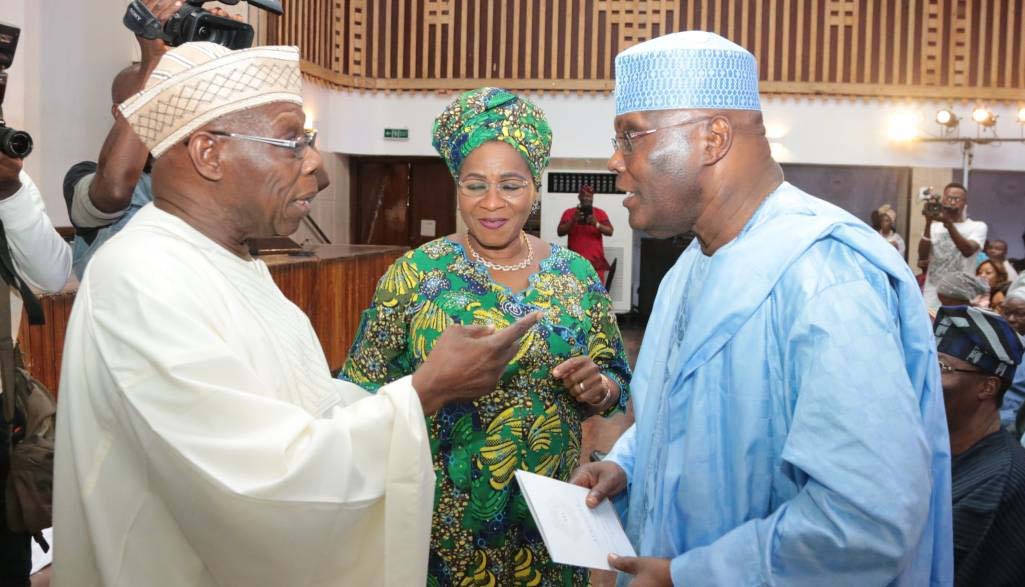
Former Vice-President Atiku Abubakar has responded to former President Olusegun Obasanjo’s recent remarks, saying he has no regrets about opposing the controversial third-term agenda during their time in office.
Obasanjo, who served as president from 1999 to 2007 with Atiku as his deputy, recently said he regretted choosing Atiku as his running mate. Speaking during a fireside chat with activist Charles Oputa, popularly known as Charly Boy, in Lagos, Obasanjo claimed he later discovered things about Atiku that made him regret the decision.
He said he was grateful that God did not allow Atiku’s actions to distract him from his focus on governing Nigeria or cause harm to the country.
Reacting in a statement issued on Saturday by his Senior Special Assistant on Public Communication, Phrank Shaibu, Atiku said he received Obasanjo’s comments with sadness rather than anger, describing them as the words of a man still driven by personal resentment.
According to Atiku, Obasanjo’s hostility towards him stems from his refusal to support the former president’s alleged bid to extend his tenure beyond the constitutional two terms.
“I am proud that I stood against the third-term agenda. I am proud that I defended the Constitution of the Federal Republic of Nigeria,” Atiku said.

“I have no regrets for resisting every attempt to undermine Nigeria’s democracy for personal ambition.”
Atiku maintained that protecting the Constitution was more important than any individual, adding that if Obasanjo’s resentment was truly because of his stand against the third-term plan, he would wear it as a badge of honour.
The third-term controversy dominated Nigeria’s political landscape in 2005 and 2006 when lawmakers considered constitutional amendments that would have allowed presidents and governors to serve three four-year terms. The proposal eventually failed after the Senate rejected it in May 2006.
Atiku, who was one of the strongest opponents of the move, said history had already judged the matter in favour of democracy.
He also pointed to comments recently made by former Finance Minister, Ngozi Okonjo-Iweala, who praised the economic management team he led as vice-president.
Atiku argued that while Obasanjo might refuse to acknowledge his contributions to the administration, the country’s economic record and those who worked closely with them told a different story.
The former vice-president also recalled the role he played during Obasanjo’s imprisonment under the military regime. He said he supported Obasanjo’s family, campaigned for his release, and helped him rebuild his political career after regaining freedom.

According to Atiku, he provided financial and political support, mobilised alliances and structures that contributed to Obasanjo’s emergence as president in 1999.
Despite everything, Atiku said he does not regret helping the former president.
“When God gives you the opportunity to help someone, you do it without expecting anything in return,” he said.
He added that if Nigeria’s political history is written objectively, his role in Obasanjo’s return to power would be impossible to ignore.
Atiku further expressed disappointment that, at a time when Nigerians are grappling with economic hardship, insecurity and unemployment, a former president would focus on reopening old political disagreements instead of offering solutions to the nation’s problems.
He insisted that the 2027 elections should centre on rebuilding the country, improving security, reviving the economy and restoring hope, rather than revisiting past political conflicts.
The latest exchange adds to the long-running public feud between the two leaders, who have repeatedly accused each other of corruption, political betrayal and abuse of office since leaving government. Their war of words intensified recently after Obasanjo alleged that Atiku gave the late former Speaker of the House of Representatives, Ghali Umar Na’Abba, ₦5 million to initiate impeachment proceedings against him while he was president—an allegation Atiku has strongly denied.




