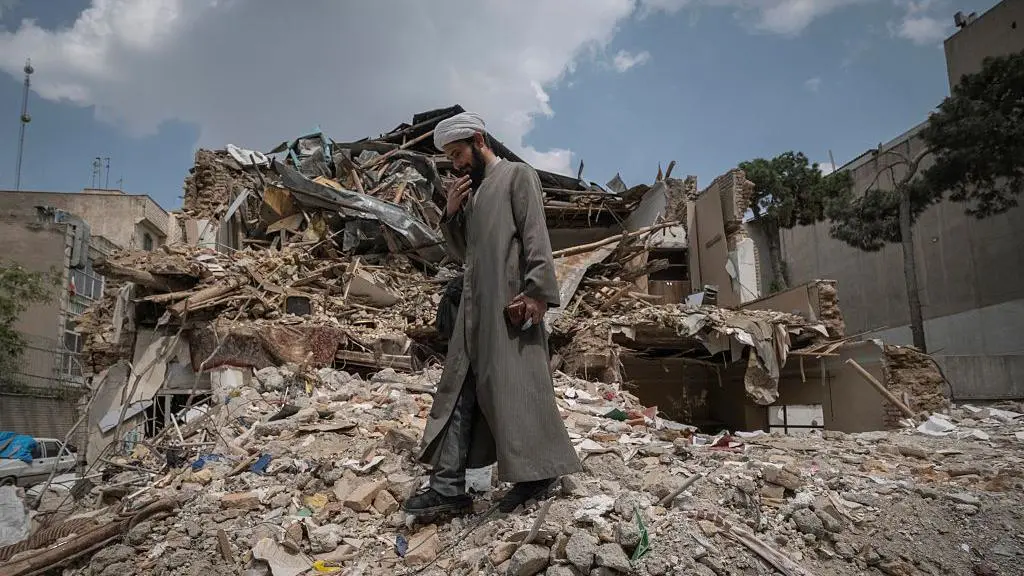
Trump is ‘lying’ and ‘desperate’ for a ceasefire, Iranian general says
The Iranian Revolutionary Guard Corps (IRGC)-affiliated Fars news agency has posted a quote on Telegram from a commander at Iran’s top military headquarters.
Writing in Persian, Major General Abdullahi says that the IRGC has driven Israel and the US “to despair and exhaustion, forcing them to desperately request a ceasefire”, according to Fars.
He says the armed forces would not allow the “lying and delusional US president” to “create false narratives of the situation on the ground”, especially on the subject of the Strait of Hormuz.
It remains unclear whether an Iranian delegation will head to Islamabad for a second round of peace talks with the US.
As our South Asia correspondent writes, there is political tension behind the scenes in Iran, with hardliners putting pressure on negotiators to choose conflict over diplomacy.
Previous Iran deal took months to agree, not days
 Frank Gardner
Security correspondent
As Donald Trump posted on social media site Truth Social, he insisted he has the upper hand in negotiations with Iran. In one post he said, “The DEAL that we are making with Iran will be FAR BETTER than the JCPOA”, he wrote, referring to the deal President Obama struck in 2015.
That is the joint comprehensive which curbed Iran’s nuclear activities in return for the lifting of sanctions that had been imposed by the UN, US and EU.
It was the crowning glory of President Obama’s foreign policy, which is probably why President Trump wanted to rip it up so quickly – by pulling the US out and effectively destroying it.
Trump announced he would pull the US out of the deal in 2018, calling it “decaying and rotten”, and reimposed economic sanctions. In response, Iran said it would prepare to start uranium enrichment.
That deal took eighteen months of the P5 plus one, the five permanent members of the UN Security Council plus Germany, sitting down for endless talks with very smart Iranian negotiators.
These are highly educated, multi-lingual people, who are right on top of their brief and this is not something you can make a quick deal over.

Oil prices dip as traders watch for peace talks clues
 Peter Hoskins
Business reporter, in Singapore
Oil prices dipped in Asian trading on Tuesday as investors watch for details of potential US-Iran peace talks.
Brent crude – a closely watched measure of oil prices – is 1.6% lower at $93.97 (£69.49), while West Texas Intermediate is down by 1.5% at $86.15 (£63.71).
The status of a possible second round of peace talks between the US and Iran in Pakistan remains unclear, with no confirmation yet from either side that they are going ahead.
Preparations in place in Islamabad, but uncertainty if talks will actually happen
 Azadeh Moshiri
South Asia correspondent, reporting from Islamabad
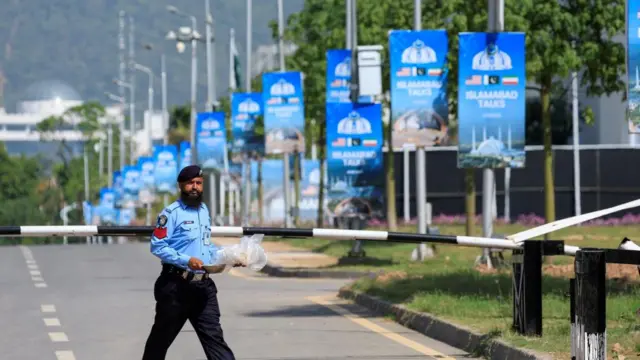 IMAGE SOURCE,REUTERS
This morning in Islamabad, preparations are still in place for possible talks. Driving through the capital, there are still security checkpoints and “Islamabad Talks” posters lining streets. But there’s also a lot of uncertainty.
The White House has said a US delegation led by JD Vance would travel to Pakistan, but the timing has been unclear.
It was thought he would have already arrived by now and yet it’s understood he spent the night in Washington on Monday.
The reason for this lack of clarity could be because of Iran’s reluctance to publicly commit to attend.
Instead, there’s still anger and fury in their statements.
The latest from Iran’s speaker of parliament Mohammad Bagher Ghalibaf, the man expected to lead Iran’s delegation, is that Iran won’t accept negotiations “under the shadow of threats”. He also accused Donald Trump of “opening a siege and violating the ceasefire”.
He’s referring to events in the Strait of Hormuz, with the US seizing an Iranian flagged cargo ship, and countering Iran’s effective blockade with one of its own on Iranian ports.
But there’s also something else going on inside Iran. Hardliners are putting pressure on figures like Ghalibaf to choose conflict over diplomacy.
That internal power struggle in a country that has seen layers of senior leaders killed over the course of this war is what is playing out behind the scenes.
Much of what we’re hearing publicly could be political bluster, and Iran could certainly be preparing to travel regardless of what officials are saying.
But all this means that just a day before the ceasefire is set to expire, we still don’t know for certain whether these peace talks will actually happen.

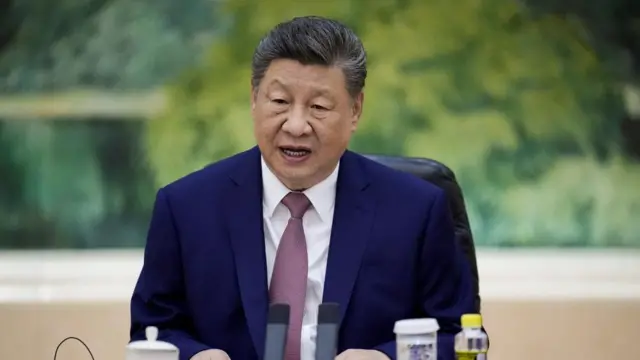 IMAGE SOURCE,REUTERS
China’s President Xi Jinping says “normal traffic” through the Strait of Hormuz “should be maintained”.
He made the comments during a phone call with Saudi Arabia’s Crown Prince Mohammed bin Salman on Monday.
Trump and Xi president are expected to meet in china by May, after the trip was initially delayed due to the US-Israel war with Iran.
‘The blockade within the blockade’
Azadeh Moshiri
South Asia correspondent, reporting from Islamabad
Returning shipping levels in the Strait of Hormuz to pre-war levels, and wresting control from Iran and its attacks, are key priorities for the United States.
Former British Royal Navy commander Tom Sharpe has described the current US strategy as “the blockade within the blockade”, telling me the White House is trying to inflict “sufficient pain” on Iran to force it to negotiate.
“Is it squeezing oil production out of Iran to the point where that pain would bring them to the negotiating table? It is hard to see what that pain level would look like and I don’t think we’re seeing it yet.”
The problem Sharpe is pointing to is that Iran has shown it is willing to absorb a high level of damage to ensure the regime’s survival.
No single individual, government, economy, or piece of vital infrastructure is more important than the Islamic Republic’s ideology, and this confrontation with the US is one it has been preparing for since its inception.
On top of that, Iranian officials insist their “sovereignty” over the Strait of Hormuz should be recognised.
They have learned that their ability to disrupt global energy markets is a powerful strategic deterrent, and even a profitable avenue should they impose long-term tolls for safe passage.
It is hard to see any Iranian negotiators willing to give that card up.
Removing enriched uranium from Iran will be a ‘long and difficult’ process, says Trump
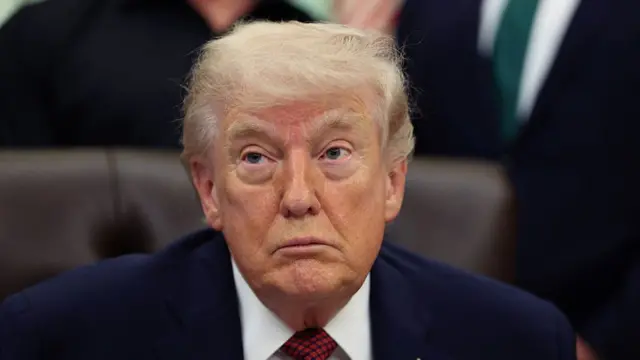 IMAGE SOURCE,GETTY IMAGES
A short while ago, US President Donald Trump has made a post to Truth Social, addressing the recovery of enriched uranium from Iran.
“Operation Midnight Hammer was a complete and total obliteration of the Nuclear Dust sites in Iran. Therefore, digging it out will be a long and difficult process,” the president wrote.
Operation Midnight Hammer is the codename for an operation carried out by the US last June, and saw 125 US military aircraft target three Iranian nuclear facilities: Fordo, Natanz and Isfahan.
He went on: “Fake News CNN, and other corrupt Media Networks and Platforms, fail to give our great aviators the credit they deserve – Always trying to demean and belittle – LOSERS!!!”
-
-
Vice-President JD Vance travelling to Pakistan today, US media reports
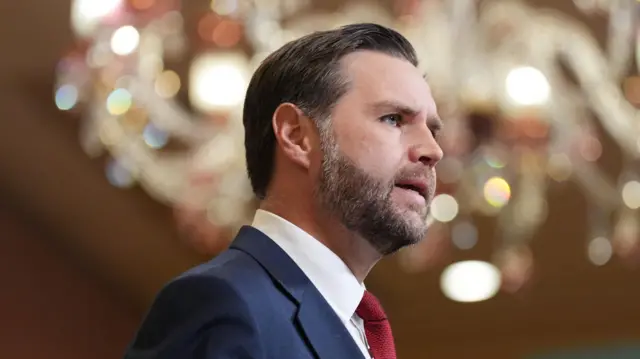 IMAGE SOURCE,REUTERS
US media are reporting that Vice President JD Vance will leave the US on Tuesday for talks in Pakistan.
Axios, citing three US sources, reported that Vance would leave by Tuesday morning.
Sources told CNN that a second round of talks between the US and Iranian delegations is currently planned for Wednesday in Islamabad.
As we reported earlier, there is still no confirmation from Iran as to wether it will attend the negotiations, but a source told the BBC on Monday that a US delegation headed by Vance will travel to Pakistan “soon”

-
With talks up in the air, this is what Iran’s officials are saying
 Ghoncheh Habibiazad
Senior reporter, BBC Persian
While there is much uncertainty about the next round of talks between Iran and the US in Islamabad, we can take a look at what Iranian officials have been saying.
Most of them have talked about their scepticism of the US, but this is nothing new.
While Iranian Foreign Minister Abbas Araghchi told his Pakistani counterpart yesterday that US actions, statements and “excessive demands” signal Washington’s “lack of seriousness for diplomacy,” it wasn’t him who said today that Iran has “no plans for the next round” – that was the foreign ministry’s spokesperson.
After Trump announced the next round of talks, we’re yet to hear from Iran’s parliamentary speaker Mohammad Bagher Ghalibaf, who was leading the delegation during the talks in Islamabad, on whether the talks are going ahead or not.
Meanwhile, Iranian President Masoud Pezeshkian said today that diplomacy “should be used to reduce tensions,” but there’s a question over how much power he actually comparatively holds.
There are voices inside the establishment who oppose the talks, including hardline clerics. But it is yet to be seen if these voices can stop the talks altogether or not.
 Lyse Doucet
Chief international correspondent, in Iran
There’s still radio silence from Iranian officials as to whether they will go to Islamabad for a second round of high-level, high-stakes negotiations.
But with every hour that passes, there is a growing sense that the talks will take place. Iranians had to make their point, even before US marines intercepted an Iranian-flagged cargo ship.
When we speak to officials here they say they have their reservations about this negotiating process, even though President Trump continues to talk about great progress, a deal within days even.
There is still concern here that the way the negotiations are taking place tend to be demands made of the Iranians that they are not ready to meet.
But they do want this process to continue, so at the end of the day there may well be talks in Islamabad this week – we just have to wait for that confirmation from both sides.
- The BBC’s chief international correspondent Lyse Doucet is reporting from Tehran on condition that none of her material is used on the BBC’s Persian Service. These restrictions apply to all international media organisations operating in Iran
Trump is offering a very optimistic view of America’s negotiating position
President Trump did not appear in front of any TV cameras or microphones on Monday. But that did not stopped him keeping us well informed as to how he is feeling about peace talks with Iran, scheduled to begin in Pakistan this week.
He posted a dozen times on his social media site, Truth Social, about the conflict with Iran, insisting he has the upper hand in any negotiations.
“I’m winning a War, BY A LOT, things are going very well,” he said in one post.
“The DEAL that we are making with Iran will be FAR BETTER than the JCPOA,” he said in another, referring to the deal President Obama struck in 2015.
He also insisted he is not in a hurry to do a deal – “I read the Fake News saying that I am under ‘pressure’ to make a Deal. THIS IS NOT TRUE! I am under no pressure whatsoever, although, it will all happen, relatively quickly!”
Trump did not offer much evidence or explanation of why he is so optimistic that a deal is in sight when it’s not even certain right now if the two sides will even meet for talks.
Other than to say – in another post – that the US naval blockade of the Strait of Hormuz is costing Iran $500m a day, which Trump says is destroying Iran.
Trump is also under economic pressure to get the strait opened and allow international shipping to resume. And there is little appetite among the American public to resume the war on Iran.
But in his posts that are untroubled by any inconvenient news or facts, Trump is offering a very optimistic view of America’s negotiating position.

Iran says it is preparing ‘new cards’ for the battlefield
As the clock ticks down on a ceasefire declared between the US and Israel with Iran, as yet there is no confirmation of further peace talks.
Iran’s parliamentary speaker posted on X to say that Iran has been “preparing to show new cards on the battlefield” in the last two weeks and would “not accept negotiations under the shadow of threats”.
Meanwhile, President Donald Trump has denied he is under pressure to make a deal, while US media report that Vice-President JD Vance will travel to Pakistan on Tuesday for talks. Trump adds that it is “highly unlikely” a two-week ceasefire between the US and Iran, due to expire on Wednesday, will be extended.
In the Gulf, the US continues to blockade the Strait of Hormuz after seizing an Iranian-flagged cargo ship on Sunday and both sides are accusing each other of ceasefire violations.
Elsewhere, a second round of talks between Israel and Lebanon is set to take place on Thursday – according to a US official.
Stay with us.