

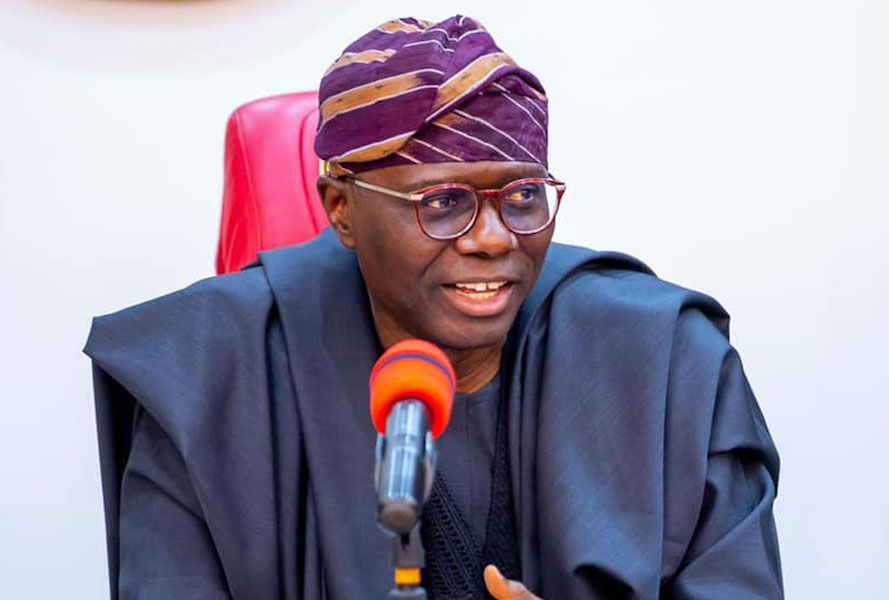
Lagos State Governor Babajide Sanwo-Olu and the Minister of Works, David Umahi, have dismissed claims that the ongoing Lagos-Calabar Coastal Highway project is responsible for the recent flooding experienced in parts of Lagos.
The two officials made the clarification on Monday during a courtesy visit by the minister and members of the National Assembly to the Lagos State Government.

Umahi said President Bola Tinubu directed an inspection of the highway project following reports circulating on social media alleging that the construction had caused widespread flooding in the state.

Recent heavy rainfall left several roads, homes and vehicles submerged across parts of Lagos, prompting some residents to link the flooding to the coastal highway project.
Rejecting the allegations, Umahi said flooding had affected several states across Nigeria and noted that meteorological forecasts had already warned of possible flooding in at least 22 states.

According to the minister, the coastal highway was deliberately designed at an elevated level to withstand ocean surges and reduce the risk of flooding for decades. He added that many of the affected communities were already located in swampy areas before construction began, making buildings below approved flood levels naturally vulnerable.
Umahi also praised the Lagos State Government for its drainage development efforts, stating that more than 80 percent of the drainage channels leading into the lagoons had already been completed.
He disclosed that the Federal Government and Lagos State would collaborate on additional drainage infrastructure and service roads along the highway corridor, although some structures would have to be removed to accommodate the projects.
The minister further revealed that consultations would be held with affected residents, while the highway corridor would eventually feature modern infrastructure such as surveillance cameras, wind monitoring stations, parking facilities and tourism attractions.

Speaking during the visit, Sanwo-Olu maintained that Lagos’ coastal location makes seasonal flooding unavoidable, noting that nearly one-third of the state’s land area is covered by water despite occupying less than one percent of Nigeria’s total landmass.
He explained that intense rainfall can temporarily overwhelm drainage systems but said floodwaters often recede after a short period.
The governor also accused some social media users of sharing images captured during peak flooding to create a misleading impression of the overall situation.
Sanwo-Olu blamed indiscriminate waste disposal for worsening flooding in many communities, saying blocked drainage channels remain one of the major causes of urban flooding in the state.
He reaffirmed the government’s commitment to enforcing environmental regulations, including the ban on styrofoam, while introducing additional measures to protect drainage infrastructure.
The governor also announced that clean-up operations had commenced along the Lagos-Badagry Expressway and revealed that a mechanised street-cleaning company had been engaged to maintain the coastal highway daily.
He added that service roads would be built alongside the highway to improve accessibility for residents and businesses, although some properties would be affected by the project.
Sanwo-Olu described the Lagos-Calabar Coastal Highway as a major infrastructure investment that would enhance economic development and improve transportation across the country.




