

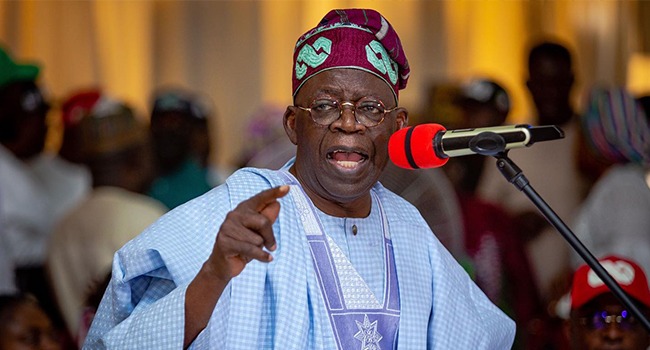
President Bola Ahmed Tinubu has reaffirmed his decision to remove Nigeria’s petrol subsidy, declaring that his administration will not return to the policy despite calls by opposition politicians for its restoration.
The President made the statement on Monday, October 19, 2026, during a political gathering tagged “Together Till 2027: An Evening with Original City Boy” at the Presidential Villa in Abuja. The event was organised by the City Boy Movement alongside the Relax-Tinubu-Is-Fixing-Nigeria movement ahead of the 2027 general election.

Tinubu defended the decision to end the subsidy on his first day in office on May 29, 2023, arguing that the country could no longer sustain the financial burden associated with the policy.
According to him, Nigeria faced serious financial difficulties when he assumed office, including outstanding obligations to airlines, pressure on foreign reserves and excessive reliance on borrowing.
“I came, and I removed the subsidy the first day,” the President said, maintaining that the government had little financial capacity left to continue funding the arrangement.
He also criticised opposition politicians who have promised to restore fuel subsidies if elected, insisting that reversing the policy would undermine the direction his administration has chosen for the country.

Using a biblical analogy, Tinubu compared the proposal to restore the subsidy to asking Moses to return to Egypt after leading the Israelites out of captivity.
“I could listen to my political opponents promising a return to subsidy. Most of all, sometimes I remember my scripture studies, both the Bible and the Holy Quran. When Moses left Egypt, they faced the challenge, and the Red Sea parted and gave way,” he said.
“You cannot ask Moses to go back to Egypt. We wake up with ideas, original thoughts, and deep thinking to move this country forward. With your energy, your support, Nigeria will never go back to Egypt. No regrets,” he added.

The President acknowledged that the past three years had been difficult for Nigerians but maintained that his administration had taken necessary decisions to address longstanding economic challenges.
He said the government had chosen to accept responsibility for the country’s financial situation rather than focus solely on the shortcomings of the previous administration.
Tinubu also expressed confidence in Nigeria’s economic direction, pointing to reported economic growth as evidence that the country was making progress. He urged his supporters to remain committed to the administration’s reform agenda.
Addressing young Nigerians at the gathering, the President called on them to mobilise support for his administration ahead of the 2027 presidential election.

He encouraged them to take the government’s message to campuses, markets and communities while urging eligible voters to obtain their Permanent Voter Cards (PVCs) and participate in the electoral process.
“Make sure every young person you know has a PVC and uses it. Tell them what we have done, and tell them what we will do. Campaign with your ideas,” he said.
Tinubu further insisted that the country’s future should take priority over the ambitions of individual politicians, describing the forthcoming election as an opportunity for Nigerians to decide the direction of the nation.
The President also defended the Students Loan Act, which he signed in 2023, saying he had no regrets about introducing the initiative. He stated that more than one million students had received support through the Nigerian Education Loan Fund (NELFUND).
Fuel subsidy removal remains one of the most consequential economic decisions of Tinubu’s administration. Its implementation led to a sharp increase in petrol prices and contributed to rising transportation and living costs, prompting sustained criticism from workers, households and opposition figures.
Former Vice-President Atiku Abubakar has proposed restoring a form of fuel subsidy if elected president, although his proposal reportedly involves a capped and audited production subsidy linked to domestic refining rather than a return to the previous system.
The Federal Government has rejected calls to reverse the policy, arguing that the country should maintain its economic reforms while pursuing measures intended to improve economic stability and growth.
Tinubu’s latest remarks reinforce his administration’s position that fuel subsidy will not be restored, even as the debate over petrol prices, economic reforms and the cost of living continues ahead of the 2027 general election.