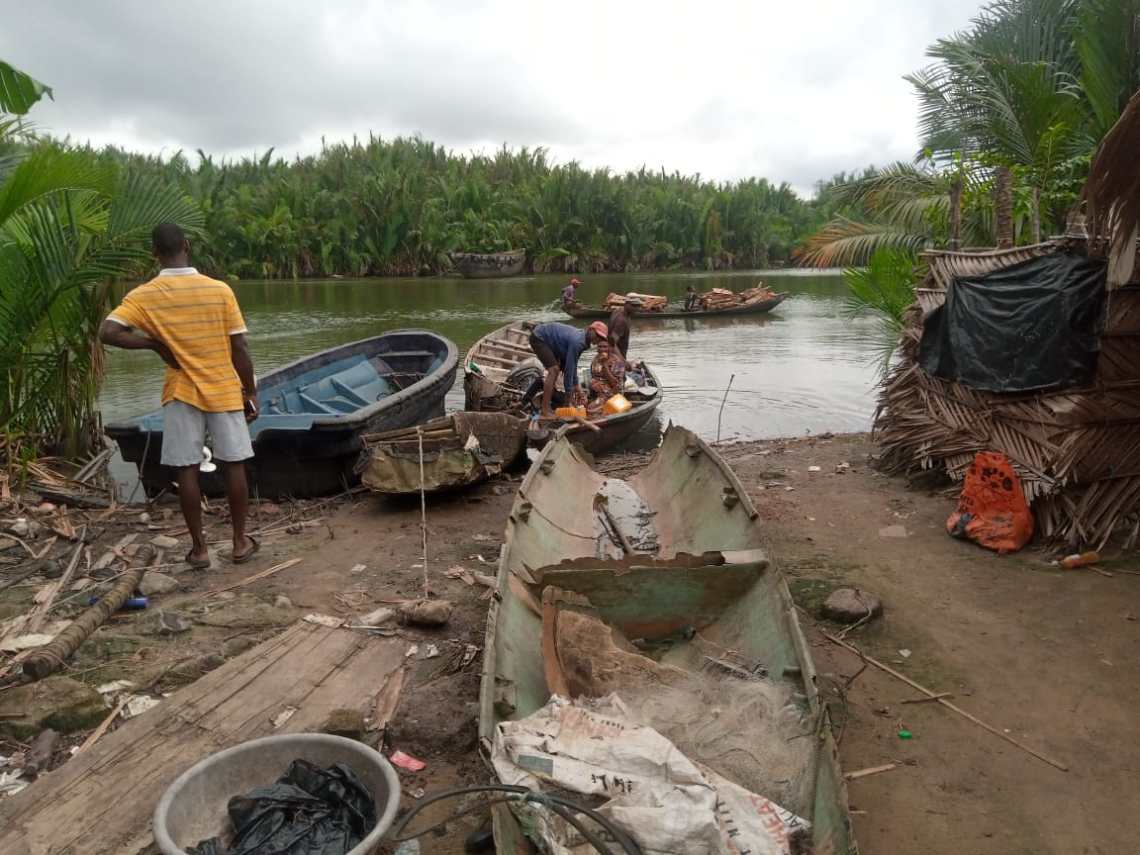
Climate change pushes fish farther offshore, deepening hardship for Nigerian coastal fishermen
Climate change is worsening the challenges confronting Nigeria’s fisheries as rising water temperatures and changing marine conditions push fish farther into deeper waters, making them increasingly difficult for small-scale fishermen to catch.
At the same time, local fishermen lack the equipment and capacity to operate in the deep sea, creating an opportunity for foreign trawlers to exploit Nigeria’s fish resources with limited monitoring.

Eyo Ambrose, a professor in the Department of Fisheries at the University of Uyo, said the situation was putting additional pressure on an already struggling fishing industry.
“Climate change is affecting our fisheries. Our local fishermen do not have the capacity to fish in the deep sea, so foreign vessels come with large trawlers, harvest the fish, and leave. There is little or no monitoring of their activities,” Ambrose said.
For fishermen in coastal communities across Akwa Ibom and the Niger Delta, the effects are already being felt through declining catches, rising operating costs and shrinking incomes.
Fishermen struggle as catches decline
In June, during the peak of the rainy season, 52-year-old fisherman Christian Inyang was at home in Ikot Inua Eyet, a fishing community in Ibeno Local Government Area of Akwa Ibom State, instead of being on the water.

According to Inyang, the waters that once sustained his family for decades no longer provide enough fish.
“There is a lot that has changed. Our catch is no longer like before. If you don’t have a big boat with a powerful engine to go far into the sea, you won’t catch anything,” he said.
For generations, fishermen in the area relied on the shallow creeks and nearby waters, using wooden canoes and relatively simple equipment to catch species such as croaker, catfish and bonga.
But residents now say much of the fish has moved farther offshore.
Inyang said that while people had explained the development to him as a consequence of climate change, he did not fully understand the science behind it.
“What I know is that the fish have gone deeper into the ocean,” he said.
The shift has forced some fishermen to seek alternative sources of income, particularly those unable to afford boats and engines powerful enough to reach deeper waters.

For Inyang, the economic impact has been severe.
“Before, a fishing trip, one week, could bring me fish worth between N700,000 and N800,000. Now, we make about N150,000 or even less. When you remove the cost of fuel, paying workers and feeding the crew, what is left is very small,” he said.
Climate change threatens coastal fisheries
Fishing has long been central to the livelihoods of communities across Akwa Ibom, Bayelsa, Delta, Rivers and Cross River states.
For many families, the trade has been passed from one generation to another, with children learning to paddle canoes and fish from their parents.
But the industry is now facing increasing pressure from climate change, inadequate investment, weak regulation and limited access to modern equipment.
The Intergovernmental Panel on Climate Change has warned that rising ocean temperatures, changing rainfall patterns, ocean acidification and sea-level rise are altering marine ecosystems. Fish species are increasingly moving towards deeper or cooler waters as temperatures rise, making them more difficult for small-scale fishermen to reach.

The Food and Agriculture Organisation has similarly warned that climate change is affecting fish distribution, breeding patterns and the productivity of coastal fisheries, particularly in developing countries where communities depend heavily on traditional fishing methods.
Nigeria is among the countries vulnerable to climate-related impacts, with rising temperatures, erratic rainfall, coastal erosion and flooding threatening livelihoods across the country.
The Federal Government has introduced climate policies, including Nigeria’s third Nationally Determined Contribution submitted in 2025, which targets a 32 per cent reduction in emissions by 2035 compared with 2018 levels and an increase in the share of renewable energy in electricity generation.
The country has also set a net-zero emissions target for 2060 under its broader climate policy framework.
However, implementation and financing remain major challenges. Nigeria estimates that about $337 billion will be required between 2026 and 2035 to fully implement its climate commitments.
For fishing communities in Akwa Ibom and the Niger Delta, the gap between policy commitments and practical support means many residents are left to cope with the changes on their own.
Declining production and rising fish prices

Nigeria’s fish industry produces about 1.2 million metric tonnes of fish annually, according to WorldFish data, with most of the production consumed locally.
Government figures indicate that production increased in 2025, but the output remains significantly below the country’s estimated annual fish consumption of about 3.6 million metric tonnes.
The Federal Government has also raised concerns over post-harvest losses, which can reach 30 per cent in the sector.
The Minister of Marine and Blue Economy, Adegboyega Oyetola, previously said such losses were undermining the availability and affordability of fish, despite its importance as a source of animal protein for Nigerian households.
Small-scale fishermen, who form the backbone of the industry, continue to face outdated equipment, inadequate storage facilities and limited access to credit and training.
These challenges are compounded by climate change and the increasing distance fishermen must travel to find fish.

Some fishermen abandon fishing
At Okorotip, another fishing community in the area, Aniedi Uwem has already shifted from fishing to crab harvesting.
“I have changed to crab catching. The fish we used to catch in the shallow waters, where we could go with our hand-paddled canoe, have moved deep into the ocean. Only very few are left,” Uwem said.
He added that fishing with his traditional canoe now often produces little or no catch.
Another fisherman, Aniefiok Edet, said the decline in fish stocks had become obvious in the community.
“In this area, we hardly see fish anymore. Instead, we hear that those who go farther into the deep sea are the ones making catches now,” he said.
The dwindling supply has also contributed to rising fish prices.
Market checks cited in the report showed that fish previously sold for about N10,000 now costs around N22,000, while quantities formerly sold for N15,000 now cost about N25,000.

A small tilapia fish that previously sold for around N3,000 was reported to have risen to about N7,000.
Rising waters threaten homes
While fish are moving farther offshore, residents say the sea and surrounding waters are also advancing towards their homes.
Communities along the coast have increasingly experienced flooding, shoreline erosion and the destruction of homes and fishing equipment.
Affiong Benjamin, a resident of Oborotip, said rising water levels were already affecting households.
“The water now comes into our houses and carries away our fishing equipment,” she said.
Residents have resorted to piling sand and other materials around their homes in an effort to prevent floodwaters from entering.
Effiong Akpan, a community leader, warned that parts of the settlement could eventually disappear if the situation continues unchecked.

“Some parts of this community are at risk of disappearing because of climate change,” he said.
He explained that fishing had become even more important because water had taken over land previously used for farming.
“Fishing is our main source of livelihood because the land we would have used for farming has been taken over by water. If nothing is done, our community and our way of life will continue to be threatened,” Akpan said.
Fishermen call for targeted intervention
For fishermen who want to remain in the industry, adapting to the changing conditions has become increasingly expensive.
Larger boats and stronger engines are required to reach deeper waters, while higher fuel prices have increased the cost of every fishing trip.
Fishermen interviewed said they had not received government assistance specifically targeted at helping them adapt to the effects of climate change.
They acknowledged that government interventions in the communities had included improvements in roads, electricity and security, but said more targeted support was needed for the fishing industry.

Inyang believes dredging the nearby river could help restore fish stocks closer to the community.
“There is too much sand now. There used to be people dredging this river, but they stopped around 2018 or 2019. Since then, the river has not been deep enough for fish to survive here,” he said.
He believes renewed dredging could improve the waterway and potentially encourage fish to return to areas accessible to local fishermen.
Experts call for research and adaptation
Brave Imiete, a marine policy analyst and director of Ocean Stewardship International in Port Harcourt, said climate change was affecting marine ecosystems and altering the relationship between fish species and their habitats.
He called for sustainable adaptation measures and greater investment in marine research to better understand the changes taking place in Nigeria’s waters.

“In the face of these challenges, it is expedient that we engage in collaborative efforts in making informed decisions to collectively adapt to these changes for the sustainability of fish stock,” Imiete said.
He also urged greater emphasis on research, innovation and adaptive management to protect marine ecosystems, preserve fish populations and safeguard the livelihoods of coastal communities.
For fishermen such as Inyang, however, climate change is no longer a distant environmental issue. It is reflected in longer journeys at sea, higher fuel expenses, smaller catches and growing uncertainty over whether each trip will provide enough income to support their families.
Without stronger support for coastal communities, modern fishing equipment, effective monitoring of foreign vessels and sustained investment in climate adaptation, the pressures facing Nigeria’s artisanal fishing sector could continue to deepen.