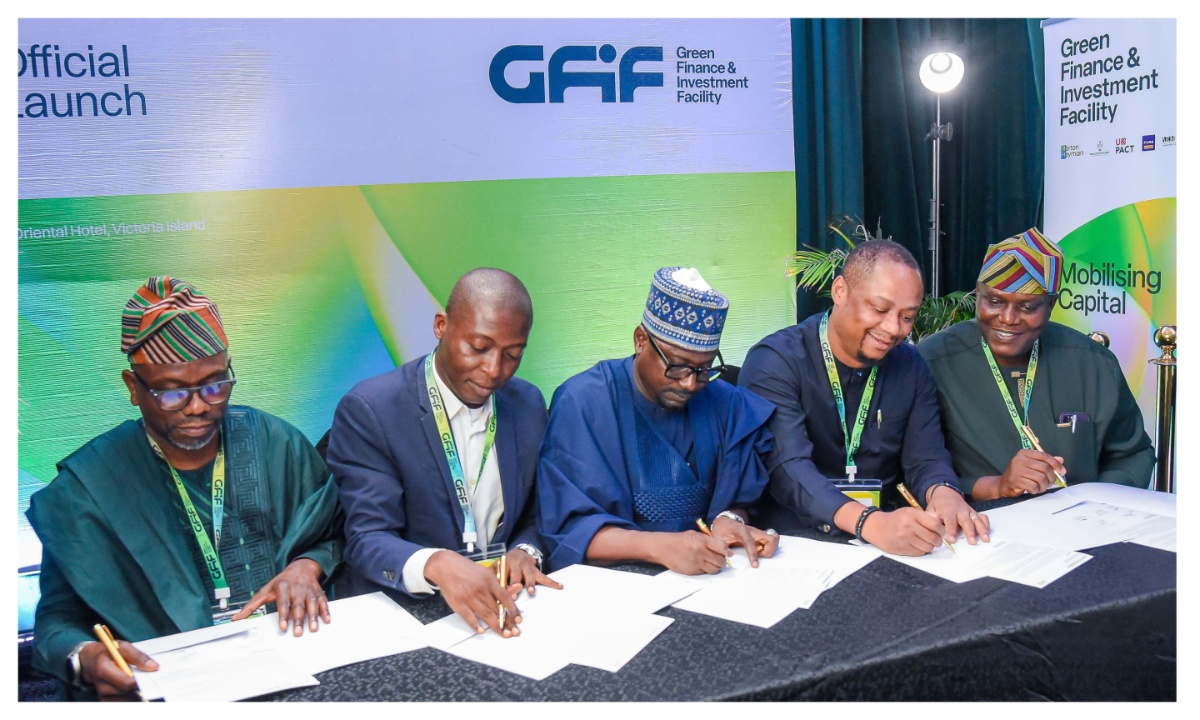
Nigeria Launches $188m Green Finance Facility to Expand Solar Power Access Nationwide
Nigeria has unveiled a new Green Finance Investment Facility (GFIF) aimed at accelerating access to clean and reliable electricity through large-scale distributed solar projects across the country.
The initiative, led by Barton Heyman Limited in partnership with the Rural Electrification Agency, UK PACT, First City Monument Bank, and ARM Harith Infrastructure Investment Limited, is expected to mobilise about $188 million for the deployment of 191 megawatts of distributed solar capacity nationwide.
The funding will support households, rural communities, and businesses under Nigeria’s broader energy access drive, including the Distributed Access through Renewable Energy Scale-Up (DARES) initiative, which focuses on decentralised power solutions to bridge the country’s electricity gap.
The facility was officially launched on May 7, 2026, in Lagos, bringing together financial institutions, renewable energy developers, policymakers, and development finance stakeholders to design a blended financing model for Nigeria’s clean energy transition.
Speaking at the launch, Managing Partner of Barton Heyman Limited, Olumide Lala, described the platform as a scalable model capable of unlocking private capital for Nigeria’s energy sector.

He said the initiative goes beyond financing, noting that it is designed to directly support over one million Nigerians through improved electricity access.
According to him, Nigeria’s distributed renewable energy sector can attract large-scale private investment by combining sovereign support, results-based funding, and commercial capital.
He added that the long-term ambition of the platform is to raise up to $40 billion to deliver about 20 gigawatts of distributed renewable energy.
Also speaking, Senior Partner at Barton Heyman, Anthony Feyitimi, said the facility is not just about clean energy but about unlocking broader economic opportunities.
He explained that reliable electricity remains central to business growth, job creation, and industrial productivity, especially in underserved communities.
“The GFIF Pilot is our first $188 million step. The ambition is $40 billion and 20 gigawatts. We are building it from Nigeria, for Nigeria,” he said.
Managing Director of the Rural Electrification Agency, Abba Aliyu, said the initiative directly addresses one of the biggest challenges in the sector — access to finance.
He noted that the partnership is designed to ensure that communities without reliable electricity can be effectively reached through sustainable investment models.
Speaking on behalf of First City Monument Bank, senior banking executive George Ogbonnaya highlighted the bank’s growing involvement in renewable energy financing.
He disclosed that FCMB has committed ₦100 billion in debt financing under the DARES programme and is currently supporting multiple mini-grid developers across Nigeria.
According to him, the bank has financed over 42 mini-grid projects and is working to support electrification for more than 2 million households nationwide.
Other stakeholders, including representatives from ARM Harith Infrastructure Investment Limited, the British High Commission, and the Lagos State Government, reaffirmed support for stronger collaboration, policy alignment, and investment mobilisation in the renewable energy space.
Nigeria continues to struggle with unreliable electricity supply, with millions of households and businesses still off-grid or underserved. Stakeholders say initiatives like the GFIF could play a key role in closing the financing gap and accelerating the country’s transition to cleaner, more sustainable energy systems.