

Headlinenews.news Special Analysis
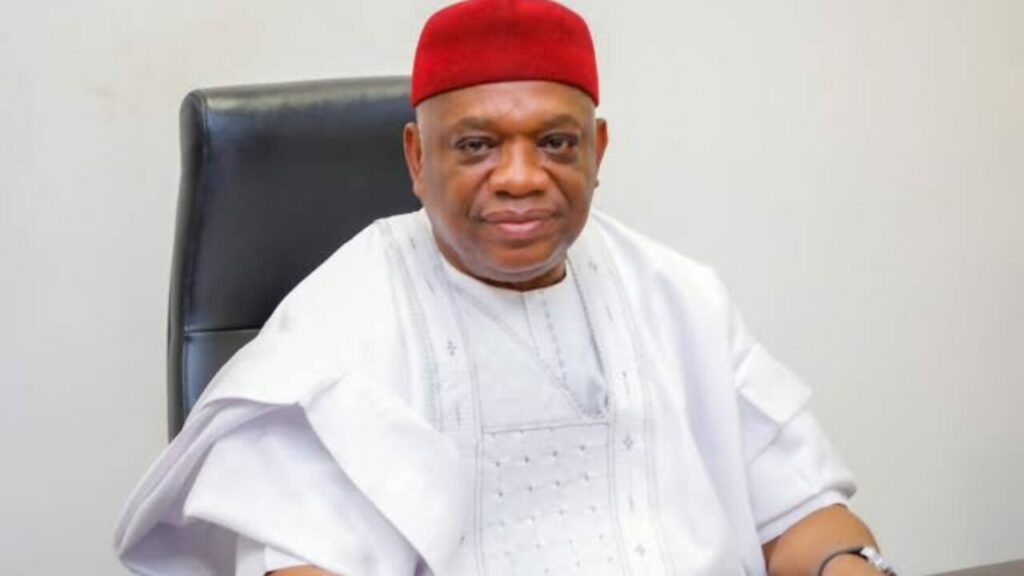
One of the enduring paradoxes of Nigeria’s democracy is that corruption cases often end up raising more questions about procedure than about the allegations themselves. Perhaps no case illustrates this contradiction better than that involving former Abia State Governor and Senator Orji Uzor Kalu.

Today, the former governor occupies influential positions in the National Assembly and chairs oversight committees investigating public institutions. Yet his name remains inseparable from one of Nigeria’s most prominent corruption cases—a legal saga that has come to symbolize the uneasy relationship between law, justice and technical procedure.
Following his tenure as governor of Abia State between 1999 and 2007, the Economic and Financial Crimes Commission (EFCC) commenced investigations into allegations involving about ₦7.65 billion in public funds. The Commission subsequently arraigned Orji Uzor Kalu, his former Director of Finance, Udeh Udeogu, and Slok Nigeria Limited on a 39-count charge bordering on alleged diversion of state funds.
After years of proceedings, the matter was heard by Justice Mohammed Idris of the Federal High Court.
However, before the conclusion of the trial, Justice Idris was elevated to the Court of Appeal. To prevent the waste of years of judicial proceedings, Section 396(7) of the Administration of Criminal Justice Act, 2015, permitted an elevated judge to return and conclude criminal cases already substantially heard, subject to approval by the President of the Court of Appeal.
Justice Idris secured the approval of the then President of the Court of Appeal, Justice Zainab Bulkachuwa, and returned to conclude the trial.
In December 2019, he convicted Orji Uzor Kalu and Udeh Udeogu, sentencing them to twelve years and ten years imprisonment respectively.

For many Nigerians, it was a landmark victory in the country’s anti-corruption war. It appeared that years of painstaking investigations and prosecution had finally yielded results.
But the victory was short-lived.
At the Supreme Court, the principal issue was not whether the evidence was fabricated or whether the defendants were innocent. Rather, the question centered on jurisdiction and constitutional competence.
The apex court held that Justice Mohammed Idris, having become a Justice of the Court of Appeal, lacked constitutional authority to return to the Federal High Court to conclude the matter. Consequently, Section 396(7) of the ACJA was declared unconstitutional.

The Supreme Court nullified the conviction and ordered a retrial.
The ruling effectively wiped away years of proceedings.
To legal scholars, the judgment reinforced the supremacy of the Constitution over ordinary legislation. To critics, however, it represented another example of how procedural defects can defeat years of substantive justice.
Before the retrial could commence, fresh legal disputes emerged. Orji Uzor Kalu approached the Federal High Court seeking to halt the retrial, arguing that the Supreme Court’s order was not expressly directed at him. The court granted relief, effectively placing the retrial on hold.
As matters stand today, Orji Uzor Kalu enjoys the full presumption of innocence because the earlier conviction no longer exists in law.

This distinction between acquittal and nullification often escapes public understanding.
A conviction overturned on jurisdictional grounds does not amount to a judicial declaration that no wrongdoing occurred. Equally, allegations remain allegations until established by a competent court. That is the essence of the rule of law.
Yet the larger question remains: can justice be said to have been served when years of proceedings collapse because of technical defects?
Nigeria is not alone in facing this dilemma.
In Brazil, corruption convictions against former President Luiz Inácio Lula da Silva were annulled on jurisdictional grounds, paving the way for his return to political power and eventual re-election. In South Africa, former President Jacob Zuma has repeatedly relied on procedural objections to challenge prosecutions, resulting in prolonged legal battles. In Israel, Prime Minister Benjamin Netanyahu continues to govern while standing trial on corruption charges, illustrating that political office and legal proceedings may coexist until final judicial determination.
These examples demonstrate that the tension between procedural fairness and substantive justice is not unique to Nigeria.

However, the Nigerian experience exposes deeper institutional weaknesses.
According to EFCC records, the agency has secured thousands of convictions since its establishment. Yet many high-profile corruption cases have suffered delays stretching over decades. Endless interlocutory appeals, technical objections and jurisdictional disputes often frustrate prosecutions and diminish public confidence.
Many experts have therefore advocated the establishment of specialized anti-corruption courts with strict timelines and limited interlocutory appeals. Others have called for constitutional amendments to ensure that years of criminal proceedings are not rendered nugatory by avoidable procedural complications.
Another school of thought argues that public officials facing serious allegations should voluntarily recuse themselves from oversight responsibilities pending final resolution of their cases, even though they enjoy constitutional rights and the presumption of innocence.

The debate touches on a philosophical question that has troubled societies for centuries.
Law and justice are not always identical.
Something may be legally correct and yet leave society dissatisfied. Conversely, popular sentiments cannot override constitutional guarantees. Democracies survive because they subject emotions to legal principles, however inconvenient.
The Orji Uzor Kalu case therefore transcends one individual.
It raises fundamental questions about the kind of justice system Nigeria seeks to build. Should efficiency be sacrificed at the altar of procedure? Can technicalities continue to erase years of judicial effort? How can anti-corruption agencies ensure that painstaking investigations are not lost through avoidable constitutional defects?
These questions demand urgent national reflection.
Anti-corruption wars are not won through dramatic arrests or sensational headlines. They are won through meticulous investigations, airtight prosecutions, constitutional compliance and judicial certainty.
Justice must not only punish wrongdoing; it must also withstand scrutiny.
For when procedure defeats substance, society is left with unanswered questions, institutions suffer credibility deficits, and citizens begin to wonder whether the law is delivering justice or merely administering technicalities.
That question, perhaps, is bigger than Orji Uzor Kalu himself.
It is a question about the future of justice in Nigeria.
Princess G. Adebajo-Fraser MFR
President, The National Patriots.




