

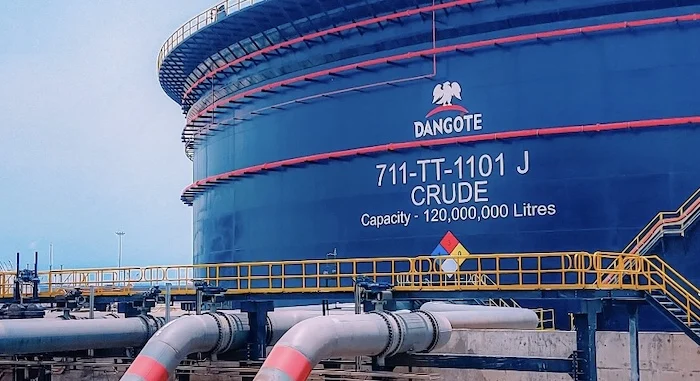
The Nigerian Midstream and Downstream Petroleum Regulatory Authority (NMDPRA) has disclosed that the Dangote Petroleum Refinery has increasingly depended on imported gasoline blendstock to support its fuel production activities, despite receiving both local and imported crude oil supplies.
Industry statistics for May 2026 indicate that the 650,000 barrels-per-day refinery brought in about 1.46 billion litres of intermediate products and gasoline blendstock between January and May 2026. These imports were used alongside crude oil feedstock to sustain operations and boost petrol output.

The data show that the refinery maintained strong production levels, recording an average petrol output of about 44.7 million litres per day in May and operating at a capacity utilisation rate of 101.25 per cent.
Between January and May, monthly blendstock imports fluctuated significantly, starting at 658.31 million litres in January, dropping in February and March, and rising again in April and May, when 240.59 million litres were recorded.
Despite improved access to crude oil, the refinery continued to supplement production with imported intermediates, a move that helped it maximise output and maintain near-full capacity operations.

The refinery also produced diesel and aviation fuel in large volumes during the period, supplying a significant portion to the domestic market while exporting part of its output. Crude receipts varied across the months, peaking in March before easing slightly in May.
Although crude supply improved during parts of the period, the data suggest that imported blendstocks remained an important input in sustaining high production levels, especially when crude availability fell short of full capacity requirements.
Nigeria’s state-owned refineries remained shut during the period, leaving the Dangote Refinery as the dominant operational refining facility in the country.

Energy experts explain that gasoline blendstock consists of intermediate petroleum streams used to improve petrol quality, enhance refining efficiency, and increase total output. They note that the practice is common globally and helps refineries optimise performance and meet fuel standards.

However, concerns were also raised about the economic impact of continued imports, particularly in relation to foreign exchange outflows, even though experts stressed that the practice is not unusual and supports operational flexibility.




