

Over 558,900 High-Dose Tramadol Pills Seized as Intelligence-Led Operation Exposes Sophisticated Cross-Border Drug Network
By Headlinenews.News Investigations Desk
In what has been described as another major victory in Nigeria’s war against illicit drugs, operatives of the National Drug Law Enforcement Agency (NDLEA), working on credible intelligence, have intercepted a truck carrying 558,900 pills of 250mg tramadol ingeniously concealed inside a specially fabricated compartment beneath the vehicle.
The truck reportedly travelled through Togo and the Republic of Benin before entering Nigeria, with traffickers believing the elaborate concealment would defeat security checks at multiple international borders.
Instead, the journey ended in Lagos.
Acting on actionable intelligence, NDLEA officers intercepted the vehicle and subjected it to a meticulous search. When conventional inspection failed to reveal the hidden cargo, officers deployed metal-cutting equipment to slice through thick steel plates welded beneath the truck’s floor. What emerged confirmed the sophistication—and desperation—of international drug trafficking syndicates.
Hidden inside specially constructed steel compartments were 558,900 tablets of high-dose 250mg tramadol, a strength that far exceeds what is ordinarily used in routine medical practice and is frequently associated with illicit trafficking.
The seizure once again demonstrates that today’s drug cartels are becoming increasingly innovative in their methods of concealment. From false fuel tanks and specially fabricated truck compartments to hidden cavities in machinery and shipping containers, traffickers continue to invest heavily in sophisticated smuggling techniques.
Yet the operation also highlights the growing effectiveness of intelligence-led policing.
Rather than relying solely on routine checkpoints, Nigerian law enforcement agencies are increasingly disrupting organised criminal networks through surveillance, intelligence gathering and inter-agency cooperation.

The latest interception prevented hundreds of thousands of dangerous opioid tablets from reaching Nigerian streets, schools, transport parks and communities.
The consequences of such a shipment succeeding would have been devastating.
Medical experts warn that tramadol abuse can lead to addiction, seizures, respiratory depression, impaired judgment, psychiatric complications and, in severe cases, death. Beyond its devastating health effects, high-dose tramadol has increasingly become associated with violent crime, cultism, kidnapping, banditry and insurgency, where it is often abused to suppress fear, increase aggression and prolong physical endurance.
Across West Africa, authorities have repeatedly identified Nigeria as both a destination and transit corridor for illicit pharmaceutical trafficking because of its large market and strategic location.
International criminal syndicates exploit porous borders, forged documentation and sophisticated concealment techniques to move narcotics across the sub-region.
This latest seizure therefore represents more than a successful drug interception. It is a significant disruption of an organised transnational criminal enterprise.
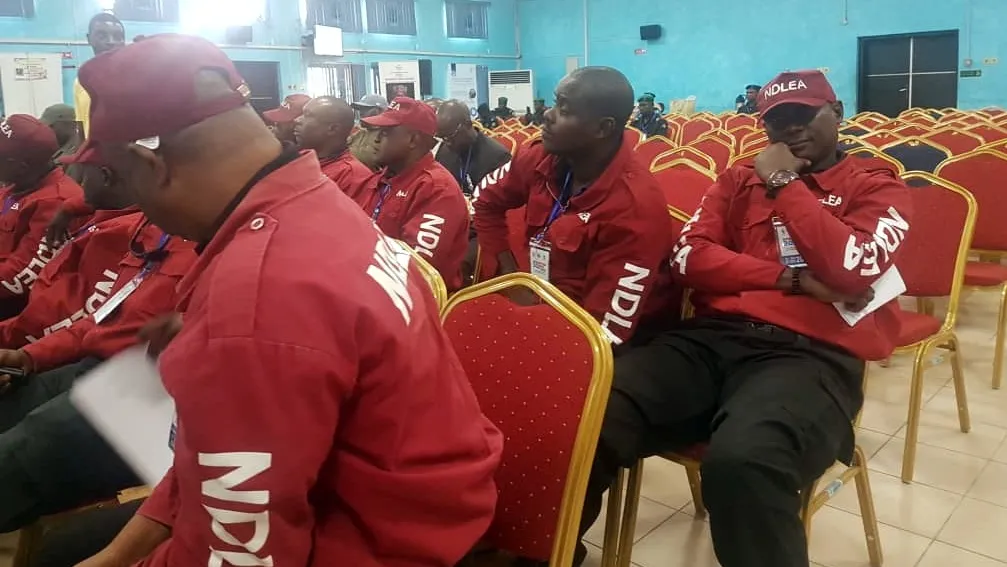
The professionalism displayed by NDLEA operatives deserves commendation.
Equally deserving of recognition is the support provided by the Nigeria Police Force and other security agencies whose intelligence collaboration continues to strengthen the country’s fight against organised crime.
However, enforcement alone cannot eliminate the menace.
The enormous financial rewards available to traffickers continue to attract criminal organisations willing to take enormous risks. Many analysts argue that stronger prosecution, faster judicial processes, confiscation of criminal assets and tougher penalties remain essential components of an effective anti-drug strategy.
At the same time, prevention remains the first line of defence.
Parents, schools, religious institutions, community leaders and civil society organisations all have a responsibility to educate young people about the dangers of substance abuse before criminal networks recruit them as users, couriers or distributors.
Nigeria’s drug problem is no longer simply a public health issue.
It is increasingly a national security issue.
Every shipment intercepted represents thousands of lives protected, countless crimes prevented and another financial blow against organised criminal syndicates.
The war against illicit drugs cannot be won by the NDLEA alone.
It requires the vigilance of every Nigerian.
Citizens must continue to provide credible intelligence to law enforcement agencies, reject drug abuse within their communities and refuse to shield traffickers whose activities destroy families, fuel insecurity and undermine national development.
The discovery of this hidden consignment sends a powerful message: no concealment is perfect, no trafficking network is beyond the reach of intelligence-driven policing, and Nigeria’s security agencies are steadily tightening the net around the merchants of death.
Dr. Imran Khazaly.
Headlinenews.news Special Investigative Report.




