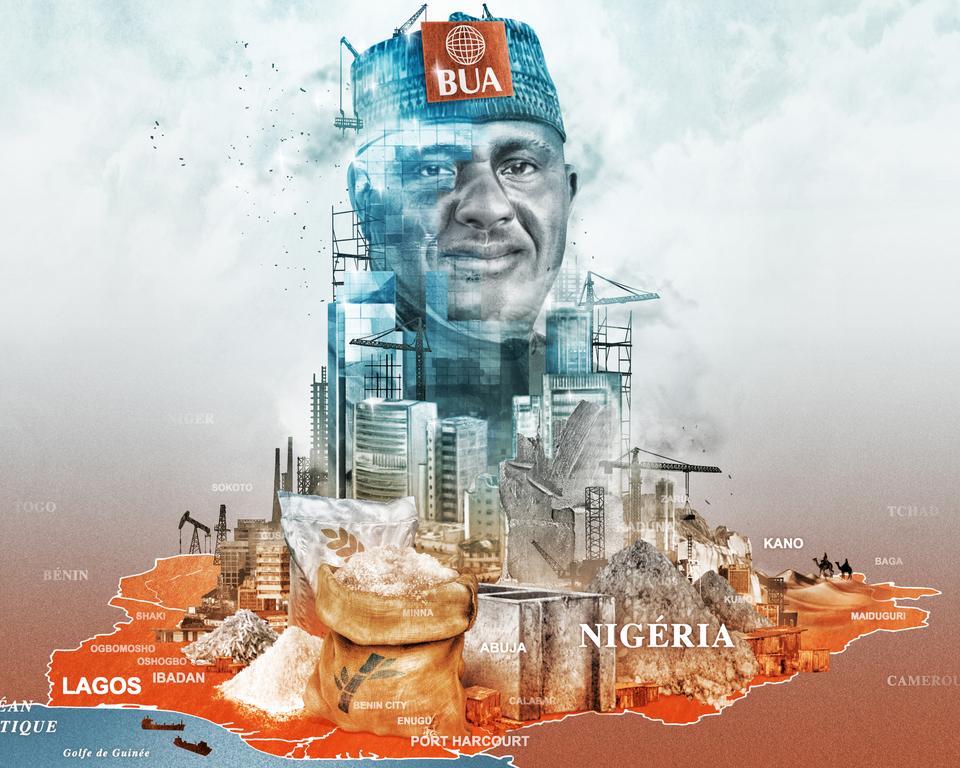
Abdul Samad Rabiu has emerged as one of Nigeria’s most influential industrialists, building a business empire around manufacturing, food production, cement, agriculture, infrastructure and logistics.
The founder and Chairman of BUA Group established the conglomerate in 1988 and has steadily transformed it from a trading business into a major industrial group with interests spanning cement manufacturing, sugar refining and plantations, rice, flour and pasta production, oil and gas, construction, real estate and logistics.
Rabiu’s approach to wealth creation is closely tied to Nigeria’s enormous domestic market. Rather than focusing solely on trading, his investments have increasingly centred on producing essential goods locally and developing the infrastructure needed to support industrial growth.
His two publicly listed companies, BUA Cement and BUA Foods, have become important players in Nigeria’s economy. BUA Foods, in particular, operates across key food categories and has benefited from strong demand for staple products in a country of more than 200 million people.

A different industrial strategy
While Rabiu is often compared with fellow Nigerian billionaire Aliko Dangote, his business strategy has its own characteristics. A recent profile by Le Monde described Rabiu as an industrialist focused on consolidating and integrating businesses in sectors such as food, cement, agriculture, logistics and energy, with Nigeria remaining at the centre of his investment strategy.
The strategy reflects a broader belief: Nigeria’s economic future depends on its ability to manufacture more of what its population consumes.
For Rabiu, industrialisation is therefore not simply about building companies. It is about creating production capacity, strengthening supply chains and reducing the economy’s dependence on imports.

Betting on Nigeria
Rabiu has repeatedly argued that Nigeria remains a country worth investing in despite its economic difficulties. In a 2025 interview, he discussed the impact of economic reforms, including fuel-subsidy removal and exchange-rate changes, while stressing the importance of stability, infrastructure and policies that encourage private-sector investment.
His optimism is supported by Nigeria’s huge consumer market and growing demand for food, housing, infrastructure and other essential products.
But the industrialist’s ambitions also come with challenges. Nigeria continues to struggle with high production costs, infrastructure gaps, insecurity, inflation and limited access to reliable energy. These factors make large-scale manufacturing considerably more difficult and expensive.
Philanthropy as part of the vision
Rabiu’s influence extends beyond business. Through the Abdul Samad Rabiu Africa Initiative, he has committed substantial resources to healthcare, education and other development projects. BUA describes the initiative as an annual $100 million fund dedicated to sustainable development across Africa.
His philanthropy reflects another part of his vision: that private wealth can be deployed to address some of the social and infrastructure challenges facing African countries.

The bigger picture
Rabiu’s rise represents a broader shift in Nigerian business—from fortunes built primarily around trading and commerce towards wealth created through large-scale manufacturing and industrial investment.
Whether his ambition can ultimately help transform Nigeria will depend not only on BUA’s investments but also on the wider business environment. Reliable power, better transport infrastructure, predictable regulation, access to finance and stronger agricultural supply chains remain essential for industrialisation.

Still, Rabiu is placing a substantial bet on the country.
His message is clear: Nigeria’s enormous problems can also represent enormous opportunities—and the country can become stronger by producing, processing and building more at home.