

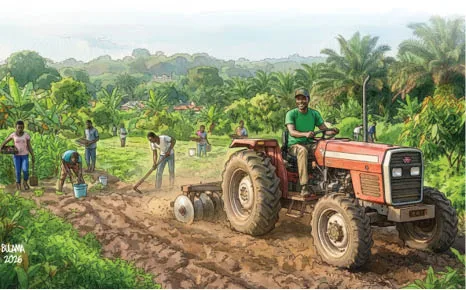
Northern migrants turn to mechanised rice farming in Ogun as Magboro project transforms livelihoods
A quiet agricultural transformation is taking place in Magboro, a community along the Lagos-Ogun border, where motorcyclists, factory workers, teachers, traders and professionals are increasingly turning to mechanised rice farming.
The shift is particularly noticeable among northern Nigerians who previously travelled between the North and South depending on the farming season. Rather than returning home to cultivate their farmlands, many are now choosing to remain in Ogun State, where they have found opportunities in large-scale rice production.
For years, Lagos and its surrounding areas attracted thousands of young people from states such as Borno, Kebbi, Katsina and Jigawa in search of work. Many became commercial motorcycle riders, factory workers and other informal-sector employees.

But for some of them, those jobs provided little financial security.
Today, the growing rice farms in Magboro are offering an alternative.
From factory work to farming
One of the farmers, Ali Adamu from Borno State, recalled arriving in Lagos with hopes of securing a stable factory job.
He eventually worked at an aluminium factory, where he earned less than ₦60,000 a month despite working long hours.
According to him, most of his income went into food and transportation, leaving little or nothing to save.
His situation changed after joining the rice farming project.
He now cultivates his own portion of farmland, works as a labourer on other farms and earns income regularly. He also receives food while working and expects to have enough rice at harvest to feed his family and sell the surplus.
Adamu said farming requires patience and hard work but provides better prospects and greater peace of mind than his previous employment.
For him and many other northern farmers, the relative security of Ogun State is another major attraction, particularly for those whose communities back home have been affected by insecurity.

‘Agriculture is serious business’
Another farmer, Mustapha Bello from Kebbi State, said many Nigerians still underestimate the potential of agriculture.
He argued that farming should no longer be viewed as an occupation reserved for poor rural communities.
According to Bello, the Magboro project has expanded considerably since its establishment more than three years ago.
This season alone, more than 1,000 bags of rice seeds were planted, with farmers expecting one of the project’s biggest harvests.
The project operates during both the rainy and dry seasons, and participation continues to grow as more people witness the results.
Bello attributed much of the expansion to Alhaji Muhammed Bello Besse, the Sarkin Noma of Ogun State, who helped transform the small-scale initiative into a mechanised farming operation.
The first farmers were reportedly northern commercial motorcycle riders living around Magboro. They began cultivating rice on a small scale before Besse encouraged them, secured additional land and introduced modern agricultural equipment.
Tractors, planters and harvesters subsequently made large-scale cultivation possible and attracted professionals and other investors.
Bello believes the Magboro operation is among the largest rice farming projects in southern Nigeria and appealed to the federal and Ogun State governments to provide more support through irrigation, improved seedlings, machinery and infrastructure.
A French teacher becomes a farmer
The project has also attracted people without traditional farming backgrounds.
Adam Abdulwahab, a part-time French teacher in Lagos, turned to rice farming because his teaching schedule provided limited income.
With classes only a few times a week, Abdulwahab decided to use his free time to learn agriculture.
He initially knew nothing about rice cultivation but was taught how to clear land, prepare fields, transplant seedlings, apply fertiliser and use herbicides.
He eventually acquired his own farmland and began working on other farms for additional income.
He said farming has given him financial independence because he no longer has to wait until the end of the month to earn money.
For Abdulwahab, agriculture has moved beyond a side hustle.
“It has become my future,” he said.
Insecurity pushes farmers south
For others, the move to Ogun is directly connected to insecurity in the North.
Ali Bukar, another Borno indigene, grew up in a farming family but was forced to abandon agriculture because of attacks on farming communities.
He eventually relocated south after hearing about the Magboro project.
According to him, the major difference between farming in Borno and Ogun is the security environment.
While farmers in parts of the North often worry about attacks, those in Magboro can concentrate on production.

He described the opportunity as a chance to return to the profession he had known since childhood, but this time with access to modern machinery and a safer environment.
Why some abandoned okada riding
For Mustapha Sama’ila from Katsina State, rice farming became an alternative after he became frustrated with commercial motorcycle riding.
He said okada riding initially appeared to be one of the quickest ways to make money after arriving in Ogun.
However, the business exposed him to accidents, harassment by law enforcement officers and frequent motorcycle seizures.
After joining the rice project, he discovered that farming provided greater peace of mind and a more sustainable source of income.
He said farmers could see the direct results of their labour at the end of every season while simultaneously producing food and building assets.
From bureau de change to rice farming
The farming project is also attracting professionals.
Nasiru Abubakar, a Financial Accounting graduate from Kebbi State, previously worked in the bureau de change business in Lagos.
Before that, he worked at his local government in Kebbi, where his monthly salary was only ₦23,000.
As challenges mounted in the foreign exchange business, he began looking for alternatives.
Rice farming eventually became his preferred option.
He now regards agriculture as a long-term investment capable of generating income while contributing to food production.
Factory workers are also switching
Muhammed Isiyaku from Borno State left his job at a tomato paste processing company in Wasimi, Ogun State, where he earned about ₦85,000 monthly.
He said the income was insufficient to significantly improve his living conditions.
After being introduced to farming by friends, he resigned and joined the rice project.
Farmers are allocated portions of land to cultivate while also working on other farms for daily wages. Farm owners also provide meals to workers, helping reduce their living expenses.
‘I rode okada for 20 years without anything to show’

Usman Nuhu, who has spent more than two decades in Lagos, said he worked as a cobbler before becoming an okada rider.
He rode commercial motorcycles in Port Harcourt, Lagos and Ogun State.
Although he sometimes earned between ₦8,000 and ₦10,000 a day, he said much of the money disappeared into expenses, motorcycle-related problems and confrontations with authorities.
After almost 20 years, he felt he had little to show for his efforts.
He eventually joined the rice farming project.
Nuhu said the change has given him greater financial stability, allowing him to save and support his family. He has also brought his two wives from Kebbi State to live with him in Ogun.
Women are joining the agricultural boom
The transformation is not limited to men.
Hadiza Muhammed from Kebbi State previously sold cooked food in Lagos before investing her savings in rice farming.
With support from Bello Besse, she established her own farm and eventually left the food business to concentrate fully on agriculture.
She now employs workers and supervises a largely mechanised operation.
The production cycle takes about five months from planting to harvest, and she is already in her third year of rice farming.
Her immediate ambition is to use proceeds from her next harvest to buy a house for her elderly mother in Kebbi.
Another farmer, Oluwaseun Oyenike from Oyo State, also switched careers.

A former hairdresser, she initially combined farming with her salon business before deciding that agriculture was more profitable.
She eventually closed her salon and began concentrating fully on rice production.
She now employs workers and manages her farm, saying agriculture has provided greater income than her previous profession.
How a small initiative became a major farming project
At the heart of the Magboro transformation is Alhaji Muhammed Bello Besse, the Sarkin Noma of Ogun State and chairman of the Albarka Farmers’ Group.
Besse recalled that the project began with a small group of northern youths who were already living in Magboro and riding commercial motorcycles.
He supported them financially, providing loans reportedly ranging from ₦1 million to ₦10 million.
After visiting their farms and seeing the fertility of the land, he recognised the project’s potential.
He subsequently worked with traditional rulers and community leaders to secure hundreds of hectares of farmland.
The group abandoned traditional farming methods and adopted mechanisation, acquiring tractors, planters, harvesters and other equipment.
According to Besse, this transformation attracted people from different backgrounds, including lawyers, teachers, traders, civil servants, graduates, factory workers, bureau de change operators and former okada riders.
Experienced rice farmers from Kebbi, Borno and Niger states have also been brought in to provide technical knowledge and train newer farmers.

Government takes interest
The rapid growth of the project has attracted the attention of government officials.
Besse said the Ogun State Commissioner for Agriculture and Food Security, Dr Bolu Owotomo, visited the farms and expressed satisfaction with the development.
Officials from Lagos State have also reportedly shown interest in possible collaboration.
Besse believes greater government investment could transform the project into a major food-production centre.
He called for support in areas such as irrigation, farm roads, storage facilities and rice-processing equipment.
He also argued that agriculture could play an important role in tackling youth unemployment by turning young people into employers rather than job seekers.
Experts promote peri-urban farming
Agricultural experts see the Magboro project as an example of the growing importance of peri-urban agriculture.
Farming close to major cities can reduce transportation costs, improve access to fresh food and create employment opportunities.
It can also contribute to food security at a time when Nigerians are facing rising food prices.
Experts have therefore called for greater government support for young farmers through affordable credit, improved seedlings, fertilisers, irrigation and agricultural extension services.
Challenges remain
Despite the progress, farmers still face several challenges.
These include:
High costs of agricultural inputs
Limited access to affordable credit
Inadequate storage facilities
Fluctuating rice prices
Rising fuel costs
Expensive operation of tractors and irrigation pumps
Poor access roads
Limited local processing facilities
Farmers particularly want better roads to make it easier to transport harvested rice during the rainy season.
They are also calling for processing centres close to the farms to reduce post-harvest losses and increase profitability.
A new agricultural narrative
As the farming day ends in Magboro, the tractors return from the fields and farmers gather to discuss the day’s work.
For many of them, the transition represents more than a change of occupation.
Former okada riders who once spent hours navigating Lagos traffic now talk about hectares of farmland and expected harvests. Factory workers who once depended on monthly salaries now earn from their own farms and daily agricultural labour.
Teachers, traders, professionals and women are also finding opportunities in the sector.
Their experiences challenge the long-standing perception that agriculture is merely a profession for villagers or people without other options.
In Magboro, farming is increasingly being viewed as a modern business—one capable of creating wealth, providing employment and helping Nigeria address its food-security challenges.




