

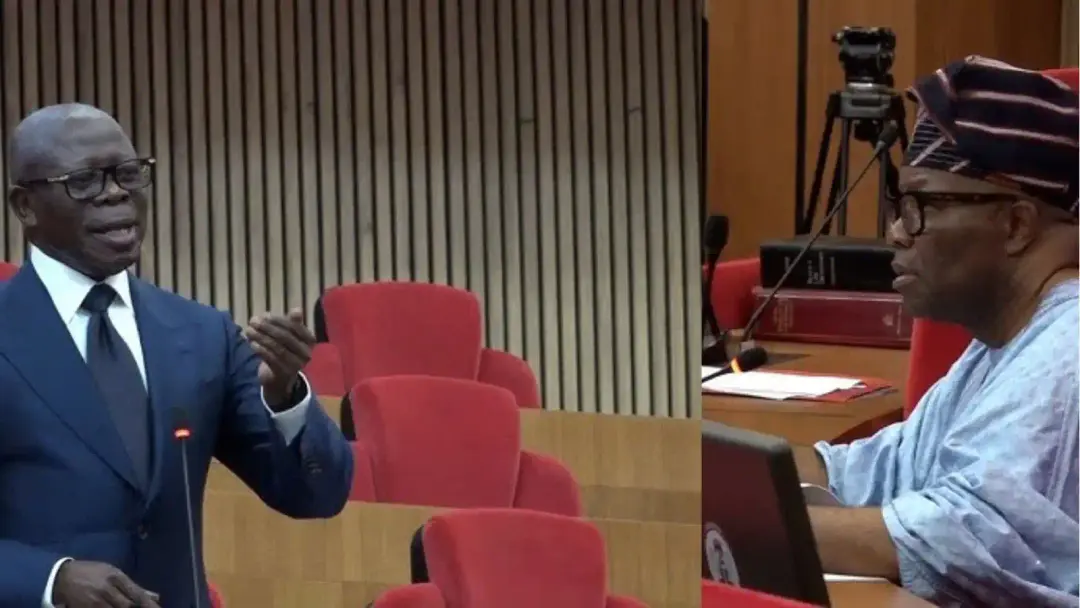
There was tension in the Senate on Wednesday as Senate President Godswill Akpabio and Senator Adams Oshiomhole engaged in a heated exchange over the interpretation of the Senate’s amended standing rules.

The disagreement began during the reading of the Votes and Proceedings from Tuesday’s sitting when Oshiomhole attempted to raise a point of order. Akpabio immediately reminded him that, under the Senate Standing Orders 2023 as amended, points of order are not entertained during that stage of proceedings.
As Oshiomhole persisted, Akpabio called on former Senate Chief Whip, Orji Kalu, to clarify the rule. Kalu supported the Senate President’s position, insisting that no point of order could be raised at that point in the session.
Despite the clarification, Oshiomhole continued speaking, prompting Senate Whip Tahir Monguno to caution him and warn that disciplinary measures could be invoked if he failed to comply with the rules.

Akpabio later issued a stronger warning, telling the Edo North senator that the Senate would apply its rules if he became disruptive during proceedings.
The clash is believed to be connected to the Senate’s recent amendment of its standing rules ahead of the 2027 general elections.
On Tuesday, the Senate amended Orders 4 and 5 of its standing rules, introducing stricter eligibility requirements for senators seeking presiding and principal offices in the 11th National Assembly.

Under the revised rules, only senators who have served at least two consecutive terms immediately before nomination will qualify to contest for positions such as Senate President, Deputy Senate President, Senate Leader, Chief Whip, and other principal offices.
The amendment also prioritises ranking and parliamentary experience, giving preference to former Senate leaders, principal officers, and lawmakers with prior legislative experience.

The development is widely seen as a move that could prevent incoming senators or those not currently serving in both the 9th and 10th Senate from contesting key leadership positions in the next assembly.
Political observers believe the changes may affect the ambitions of several politicians expected to return to the Senate in 2027, including former governors and other high-profile figures.
The Senate leadership defended the amendment, stating that it is intended to preserve parliamentary tradition and strengthen the principle of ranking within the upper legislative chamber.





https://shorturl.fm/o100S