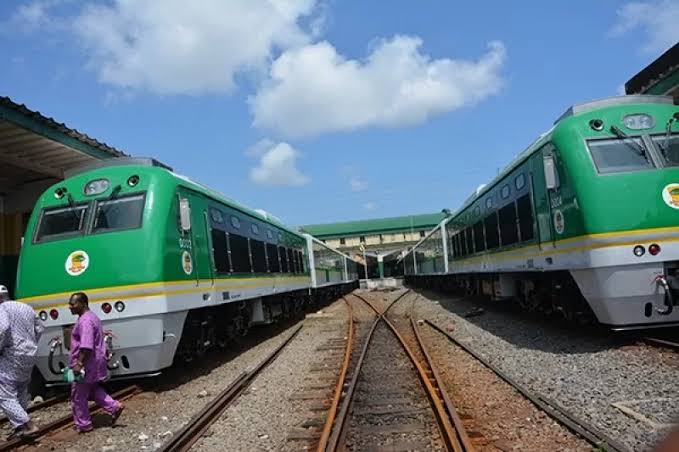
Lagos–Enugu Train: Why Nigeria Needs a Faster Alternative to Road Travel
A journey from Enugu to Lagos by road can become an exhausting ordeal on a particularly bad day. What should ordinarily be a manageable trip can stretch from 5am on one day until 7am the following morning.
In recent months, people known to this writer have experienced such frustrating journeys. One young member of the family, for instance, left Okada Junction in Edo State at about 2pm in June but spent the night inside a bus around Sagamu before finally arriving home in Lagos the following morning.
As another trip to Enugu approached, travellers were warned about three major bad spots along the route between Sagamu and Benin City, with the combined delays expected to add three or four hours to the journey. The difficult passage through the Benin bypass was another concern.
After considering the available options, the family eventually decided that if the journey had to be made by road, the safest and most comfortable choice was to service the family vehicle and replace its tyres before travelling.

The argument was simple: money spent maintaining the vehicle, including purchasing new tyres, would be an investment that would continue to benefit the family long after the trip.
The cost of the journey and other expenses associated with the family reunion soon mounted. Eventually, a family member offered to pay for the tyres. It was during this discussion that another relative raised a bigger question: Why doesn’t Nigeria have another reliable option for travelling between Lagos and Enugu?
Why not a Lagos–Enugu train?
The suggestion was straightforward: Nigeria should develop a passenger rail service connecting Lagos and Enugu.
Such a service could provide travellers with a safer, more comfortable and potentially faster alternative to road transportation. Depending on the speed of the train and the number of stops, a Lagos–Enugu journey could potentially be completed within several hours.
Nigeria already has an example of what rail travel can achieve. The 186-kilometre standard-gauge railway between Abuja and Kaduna takes roughly two to two-and-a-half hours.
With Lagos and Enugu separated by approximately 454 kilometres by road, a comparable rail connection could potentially make the journey significantly less stressful than the current road experience.
More importantly, trains can carry large numbers of passengers at once, potentially making them a cost-effective form of mass transportation.
A wider rail corridor
The proposal should not necessarily stop at Enugu.
A strategic railway could connect Lagos with Ogun, Ondo, Edo, Delta, Anambra and Enugu, before extending towards other major cities and eventually Abuja through appropriate routes.
Such a corridor would connect several important commercial and population centres while providing an alternative to increasingly congested highways.
The idea may appear ambitious, but major infrastructure projects are often born from ambitious thinking.
If rail construction costs average around $4 million per kilometre, a 454-kilometre Lagos–Enugu line would require an estimated $1.8 billion. Although that is a substantial investment, the project could be explored through a combination of federal funding, state participation and private-sector investment.
Lagos, Ogun, Ondo, Edo, Delta, Anambra and Enugu could potentially partner with the Federal Government and private investors to develop and operate such infrastructure.
A well-designed public-private partnership could spread the financial burden while creating a long-term transportation asset capable of serving millions of Nigerians.

Beyond one journey
The argument for a Lagos–Enugu railway is not simply about making family trips easier.
A reliable rail network along the corridor could improve the movement of people and goods, reduce pressure on major highways, stimulate economic activity and create opportunities for businesses located along the route.
It could also provide travellers with a safer alternative when highways become congested or dangerous.
For a country as large and economically diverse as Nigeria, transportation infrastructure should provide citizens with multiple choices rather than forcing millions of people to depend overwhelmingly on road travel.
The journey to Enugu
Eventually, the family made the trip to Enugu in a Lexus SUV, travelling to reunite with relatives and attend a wedding.
The occasion brought together family members and several prominent personalities from Enugu and beyond.
Kosisochukwu, the second son of Justina Ugochinyelu and her husband, Frank Okechukwu Offor of Uboji Ngwo, Enugu State, was getting married to Vanessa, daughter of Akunna Genevive and Jude Uchenna Enunwaonye of Umu Inai, Osa-Azbuike Ogbeku Quarters in Delta State.
The wedding took place at the historic Enugu City Hall, headquarters of Enugu North Local Government Area.
The event was attended by the Mayor of Enugu North Local Government Area, Dr Ibenaku Onoh, and his wife, Chizzy. Also present were Dr Emeka Onoh and his wife, Dr Chidimma Onoh, who travelled from the United Kingdom to support the ceremony.
Among the dignitaries at the event were the Senator representing Enugu West, Osita Ngwu; member representing Udi/Ezeagu, Sunday Umeha; Enugu State Statistician General, Chief Chris Okafor; former Vice-Chancellor of the University of Nigeria, Prof Bartho Okolo; and several other guests.
The writer served as chairman of the wedding ceremony and used the occasion to reflect on the meaning and importance of love.
Beyond the celebration, however, the experience of travelling to Enugu once again highlighted a larger national challenge.
Nigeria needs more transportation choices. A modern Lagos–Enugu railway could be one of them.