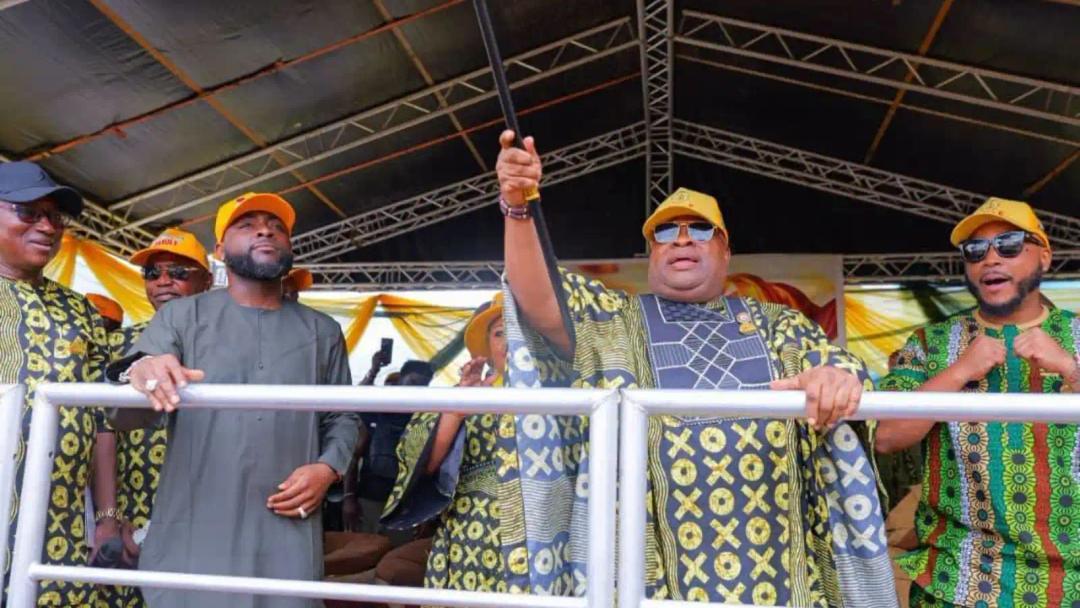
How ‘Dancing’ Adeleke Defeated Tinubu, Oyetola, Fadahunsi and APC’s Political Machinery to Retain Osun Governorship
Osun State Governor Ademola Adeleke has secured a second term in office after defeating the All Progressives Congress (APC) candidate, Bola Oyebamiji, in the August 15 governorship election.
The victory came despite a formidable APC campaign backed by President Bola Ahmed Tinubu, several governors and prominent political figures in the state.
The Independent National Electoral Commission (INEC) declared Adeleke of the Accord Party the winner in the early hours of Sunday after the final collation of results in Osogbo. He polled 511,067 votes, defeating Oyebamiji, who scored 444,815 votes, by a margin of 66,252 votes.
Najeem Salaam of the African Democratic Congress (ADC) finished third with 17,180 votes.

Adeleke won 19 of Osun State’s 30 local government areas, while Oyebamiji secured 11.
INEC Returning Officer, Joshua Ogunwole, declared Adeleke the winner after confirming that he had satisfied the requirements of the law.
The result represents another significant political victory for the governor, particularly considering the political heavyweights and machinery mobilised against him.
From ‘Dancing Senator’ to ‘Dancing Governor’
Adeleke’s energetic dancing has been a defining feature of his public image since his days in politics.
Before becoming governor, he served as senator for Osun West between 2017 and 2019 and earned the nickname “dancing senator” because of his frequent displays at public events.
His opponents later turned the habit into a political talking point, portraying his dancing as evidence that he was not serious about governance.
The criticism continued during his first term as governor. Edo State Governor Monday Okpebholo, for instance, recently mocked Adeleke over his dancing, questioning whether he placed too much emphasis on entertainment.
Adeleke, however, has consistently rejected the criticism.
Speaking during an Arise News town hall meeting ahead of the election, he said his dancing was part of his personality and insisted that it did not affect his approach to governance.
He explained that while he enjoyed dancing, he remained serious and prudent when carrying out his official responsibilities.
The election result suggests that the governor’s unconventional public image was not enough to undermine his electoral support. For many of his supporters, his personality appeared to coexist with their assessment of his administration’s performance.
APC’s Federal Might
Adeleke entered the election facing a strong APC campaign backed by some of the country’s most influential political figures.
President Tinubu was closely interested in the contest, while several APC governors travelled to Osun to campaign for Oyebamiji.
Among those who campaigned for the APC candidate were Imo State Governor Hope Uzodimma, Lagos Governor Babajide Sanwo-Olu, Ondo Governor Lucky Aiyedatiwa, Ogun Governor Dapo Abiodun, Kwara Governor AbdulRahman AbdulRazaq, Yobe Governor Mai Mala Buni, Edo Governor Monday Okpebholo, Ekiti Governor Abiodun Oyebanji and Kogi Governor Usman Ododo.
The APC’s strategy was built around combining federal influence with its political structure in the state to dislodge Adeleke.
The governor, however, repeatedly insisted that he was not intimidated by the mobilisation.

Adeleke argued that while governors could campaign for Oyebamiji, they could not cast votes for him.
The final result appeared to vindicate that position, as the Accord candidate maintained significant advantages in several of his traditional strongholds.
Oyetola’s Political Battle Continues
For former Osun Governor and current Minister of Marine and Blue Economy, Gboyega Oyetola, the election represented another chapter in his longstanding political contest with Adeleke.
Oyetola narrowly defeated Adeleke in the 2018 governorship election before losing to him in 2022.
Ahead of the latest election, Oyetola strongly backed Oyebamiji and campaigned for the APC’s return to the Osun Government House.
He had expressed confidence that the APC would reclaim the state, but the result went against the party.
Adeleke’s victory therefore represents another setback for Oyetola’s efforts to return the APC to power in Osun.
Oyinlola’s Endorsement Fails to Deliver Victory
Another notable development during the campaign was the decision by former Osun Governor Olagunsoye Oyinlola to support Oyebamiji.
Oyinlola, who had previously been associated with Adeleke’s political camp, joined former Secretary to the State Government Fatai Akinbade and former PDP Southwest National Vice Chairman Tajudeen Oladipo in endorsing the APC candidate.
Oyinlola criticised what he described as a lack of inclusiveness in Adeleke’s administration.
However, the endorsement did not translate into victory for Oyebamiji, even in Oyinlola’s immediate political environment.
At Oyinlola’s polling unit in Okuku, Odo-Otin Local Government Area, Accord polled 125 votes, while the APC received 85 votes.
Fadahunsi and the Ijesaland Factor
Senator Francis Fadahunsi, representing Osun East, was another prominent APC figure during the campaign.
He attracted controversy following the circulation of a video in which he appeared to threaten supporters of the Accord Party. Fadahunsi later clarified that his remarks were metaphorical and that he was referring to defeating Accord through votes rather than violence.
The APC nevertheless performed strongly in parts of Osun East, winning several local government areas, including Ilesa East, Atakumosa East and West, Boripe, Irepodun and Obokun.
Those victories, however, were insufficient to overcome Adeleke’s stronger performances elsewhere.
Where Adeleke Built His Winning Margin
The scale of Adeleke’s victory was driven not only by the number of local government areas he won but also by the size of his margins in key areas.

In Ede North, Adeleke polled 35,427 votes against Oyebamiji’s 10,283.
In Ede South, he secured 26,188 votes, while the APC candidate received 6,219.
Adeleke also won Ife East with 27,201 votes to Oyebamiji’s 18,600, and took Osogbo with 36,480 votes against the APC’s 30,474.
In Iwo, Adeleke recorded 27,085 votes, compared with Oyebamiji’s 19,660.
These large margins helped the governor establish a statewide lead that the APC could not overturn despite winning 11 local government areas.
Accord Gamble Pays Off
Adeleke’s decision to leave the Peoples Democratic Party (PDP) and contest under the Accord Party was one of the biggest risks of the election.
He won his first term in 2022 on the PDP platform but later left the party following its prolonged internal crisis.
His move to Accord raised questions about whether he could reproduce the political structure that had delivered his first victory while running under a much smaller platform.
The result provided his answer.
Adeleke won re-election under Accord, giving the party its first governorship victory in Osun State and establishing it as a significant political force in the state.
The governor had previously explained that he chose Accord because its philosophy of welfare aligned with his administration’s emphasis on the wellbeing of citizens and workers.
What the Osun Election Means
The outcome carries implications beyond the state.
For the APC, the defeat demonstrates that federal influence, national political figures and the support of several governors do not automatically translate into electoral victory at the state level.
For Tinubu, the result is also significant as the 2027 general elections approach. Osun remains a state where the APC’s national political machinery will have to contend with a strong local political structure.
For Adeleke, however, the victory comes with its own expectations.
Having secured another four-year mandate, the political debates over his dancing, popularity and alliances will gradually give way to questions about his performance in office.
Voters will expect the governor to justify the confidence placed in him, particularly on infrastructure, workers’ welfare, salaries, pensions, education and other areas highlighted by his campaign.
For now, however, the ballot has delivered a clear verdict.
Adeleke survived the APC’s formidable political machinery, retained his traditional strongholds and secured another four years in the Osun Government House — earning another term as the state’s famously “dancing governor.”