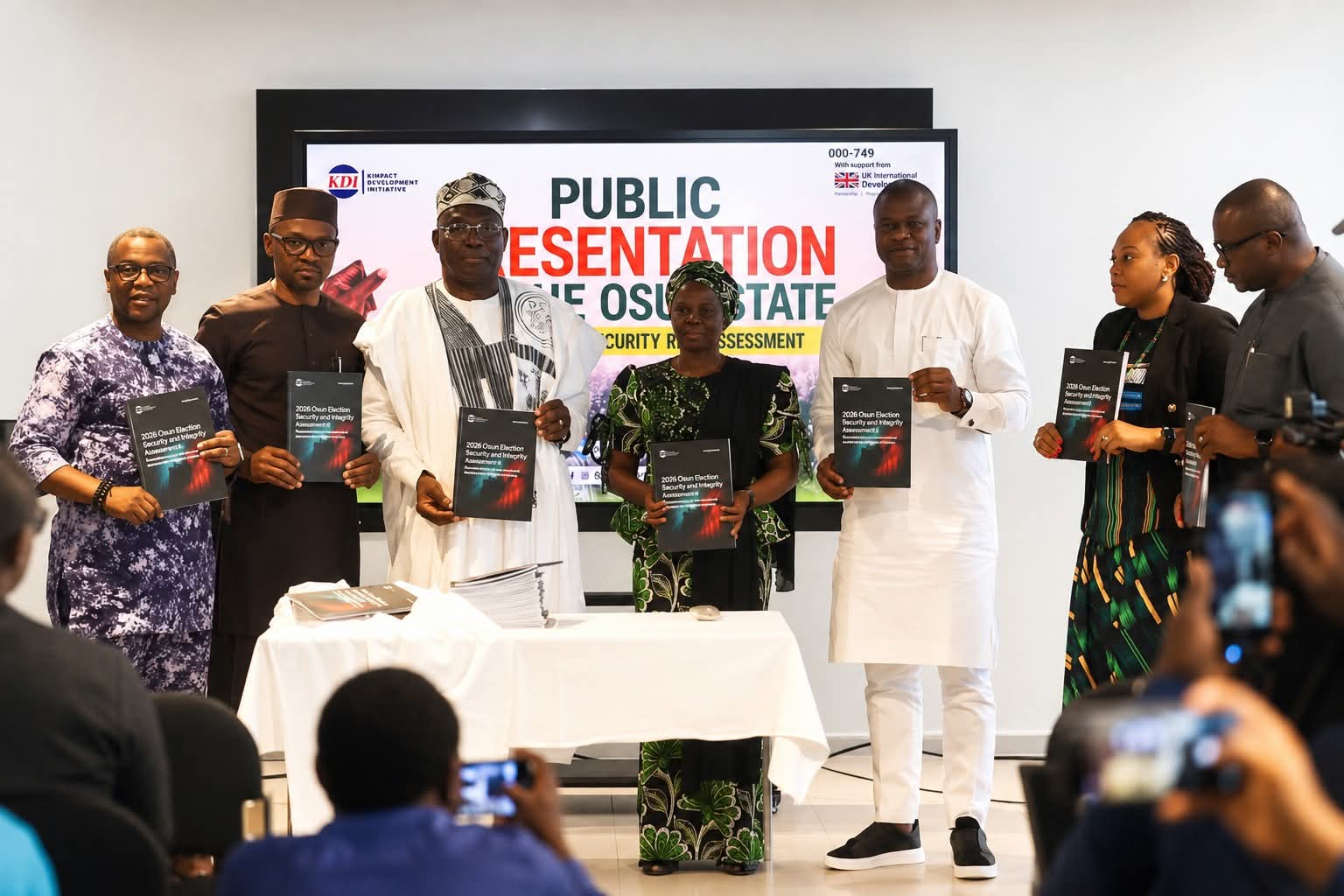
A non-partisan democracy and development organisation, KIMPACT Development Initiative (KDI), has identified Osogbo, Ede, Ilesa and Ile-Ife as areas requiring enhanced preventive measures ahead of the August 15, 2026 Osun State governorship election.
KDI disclosed this on Monday while unveiling its 2026 Osun Election Integrity and Security Assessment at a stakeholder meeting attended by members of the international observer community, diplomatic corps, civil society organisations and the media.
The report was released five days before the governorship election.
According to KDI, credible elections are not secured on Election Day alone but require sustained efforts in the weeks and months leading up to the polls through intelligence gathering, impartial institutions, responsible political conduct and informed citizens.
The organisation clarified that the assessment was not a prediction of violence or an indictment of any community, political party or institution. Rather, it was designed as a decision-support and early-warning tool to help stakeholders translate evidence into coordinated preventive action before risks escalate.

KDI also referenced the Human Rights Foundation’s 2026 Tyranny Tracker, which recently classified Nigeria as a fully authoritarian regime. While acknowledging that the methodology could be debated, the organisation said the finding served as a timely warning given the upcoming Osun election and the presidential and National Assembly elections scheduled for January 16, 2027.
The group linked the assessment to its recently released State of Democratic Performance in Nigeria 2025 report, which examined institutional accountability, citizen participation, electoral integrity, civic space and public trust across Nigeria’s 36 states.
Founded in 2014, KDI said it promotes citizen-led democratic development through elections, civic participation, policy advocacy and technology.
It noted that its network of trained, non-partisan observers had supported peaceful off-cycle elections in Edo and Ondo states, while its Ballot Integrity Project had helped strengthen scrutiny of polling-unit results.
KDI described the Osun election as particularly significant, saying it would be the last major off-cycle governorship election before the 2027 general elections and the first major competitive test of recent changes to Nigeria’s electoral framework.
The organisation said the poll would test electoral logistics, security coordination, technology deployment, results management and public confidence in the electoral process.
KDI said its assessment was based on a mixed-method and multi-source approach, comprising a citizen survey of 3,275 respondents across all 30 Local Government Areas of Osun conducted between January and March 2026; 15 key informant interviews involving political actors, security agencies, traditional institutions, women and youth leaders, civil society organisations and the media; continuous incident monitoring from October 2025 to August 2026; print, broadcast, online and social media monitoring; field observations; secondary research; and multi-stakeholder validation.

The data was analysed using KDI’s Electoral Pressure Model, which examines the interaction of political, operational, criminal, social, coercive, behavioural and information pressures across different localities, rather than relying solely on conventional hotspot mapping.
The presentation was led by KDI’s Head of Research and Strategy, Femi Adebayo, and Programme Manager, Mercy Ambiem. Discussants included Prof. Ernest Ereke, retired Assistant Inspector-General of Police, AIG Abutu Yaro and Agianpe Onyema.
KDI urged stakeholders to make full use of the report, which contains LGA-level analysis, possible scenarios and recommendations, to strengthen their deployment and engagement strategies ahead of the election.
“Early warning only has value when it produces early action,” the organisation said.
It added that the credibility of the Osun election would depend not only on the absence of violence but also on whether citizens could participate freely, institutions acted impartially, information remained truthful and lawful electoral outcomes commanded public confidence.