RMAFC Completes Review of Revenue Sharing Formula, Proposes New Framework
The Revenue Mobilisation Allocation and Fiscal Commission (RMAFC) has completed its review of Nigeria’s revenue-sharing formula and prepared a harmonised report and proposed legislation for submission to the relevant authorities.
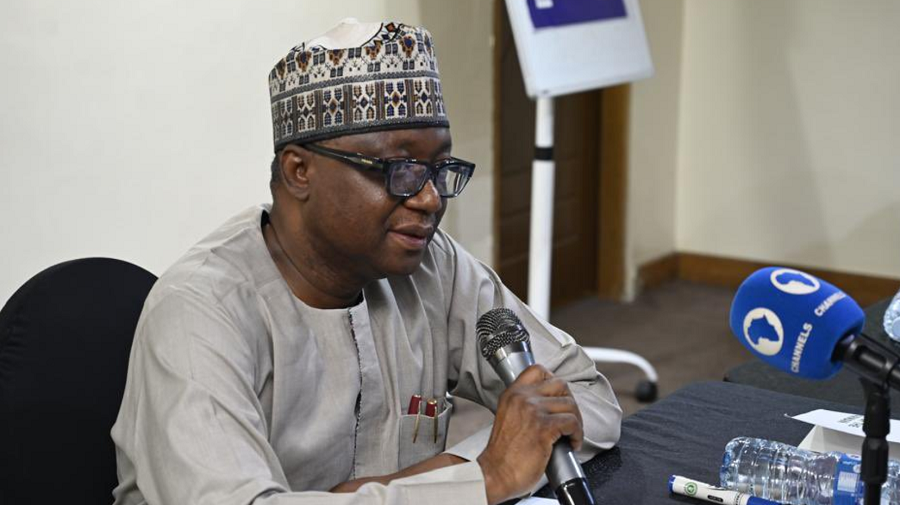
RMAFC Chairman, Mohammed Bello Shehu, disclosed this during an engagement with members of the Nigerian Guild of Editors, explaining that the review followed extensive consultations with the three tiers of government, technical experts and other stakeholders across the country.
He said the commission also examined revenue patterns, the responsibilities assigned to the Federal, state and local governments, as well as revenue-sharing arrangements in other federal systems.

According to Shehu, the objective is to establish a fairer and more sustainable revenue allocation system that reflects Nigeria’s current economic and governance realities.
The revenue allocation formula is significant because it determines how money from the Federation Account is distributed among the Federal Government, states and local governments.
Review of political office holders’ pay
Shehu also disclosed that RMAFC had made substantial progress in reviewing the salaries and allowances of political, public and judicial office holders.
He said the review of judicial officers’ remuneration had already been completed and resulted in the enactment of the Judicial Office Holders (Salaries and Allowances) Act, 2025.
The review of remuneration for executive and legislative political and public office holders, he added, was also at an advanced stage, with an executive bill expected to be presented to the National Assembly.
The proposed legislation is titled the Political and Public Office Holders (Salaries and Allowances) Act, 2026.
However, Shehu stressed that any increase in remuneration must come with greater responsibility, improved performance and stronger accountability.
RMAFC tackles derivation revenue disputes
The commission is also intensifying efforts to ensure that oil-producing states receive the appropriate revenue under the 13 per cent derivation principle.
Shehu said RMAFC had strengthened its monitoring of oil and gas production figures through verification exercises, geospatial mapping and collaboration with relevant government agencies.
These measures are aimed at resolving disputes over the ownership and attribution of oil wells.
One of the cases involved 17 oil wells that were transferred from Imo State to Rivers State following a Supreme Court judgment. Similar interventions, he said, had involved Cross River, Akwa Ibom, Imo and Anambra states.
Improved reporting of gas production has also enabled Enugu and Kogi states to receive derivation revenue to which they were entitled.

RMAFC has been working with agencies including the Nigerian Upstream Regulatory Commission (NUPRC), Nigerian National Petroleum Company Limited (NNPCL) and the Nigerian Midstream and Downstream Petroleum Regulatory Authority (NMDPRA).
The commission is also collaborating with the National Boundary Commission and the Office of the Surveyor-General of the Federation to improve revenue data and address issues affecting revenue distribution.
Oil theft remains a major concern
Shehu said RMAFC was engaging the Ministry of Defence on issues including crude oil theft and pipeline vandalism, which he described as major threats to government revenue.
According to him, reduced oil production means less revenue is available for distribution to the Federal, state and local governments.
The commission is therefore also exploring ways to expand government revenue beyond petroleum.
RMAFC is working with the Federal Airports Authority of Nigeria (FAAN) and the National Space Research and Development Agency (NASRDA) to explore the use of satellite and geospatial technology to identify revenue sources that may not have been properly captured.
Shehu said improving data integrity remained essential to ensuring accurate revenue monitoring and distribution.
He added that RMAFC had also strengthened its internal capacity through infrastructure rehabilitation, improved security, staff training, healthcare and professional development.
The chairman said the engagement with the Nigerian Guild of Editors was part of efforts to improve public understanding of RMAFC’s work and strengthen communication with the media.
He urged the media to continue helping Nigerians understand how public revenue is generated, monitored and distributed.
The proposed revenue-sharing framework will now have to undergo the necessary consideration and approval processes before it can take effect. If approved, it could significantly alter how funds are distributed among Nigeria’s three tiers of government.