

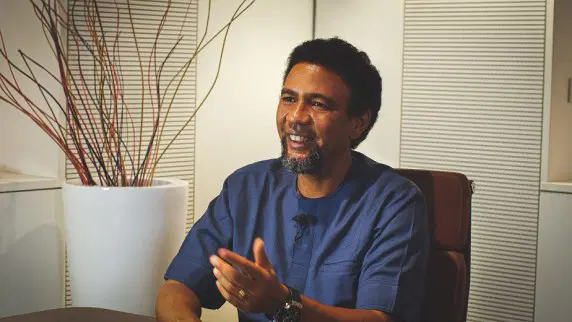
Chief Executive Officer of MTN Nigeria, Karl Toriola, has affirmed that MTN Nigeria is fundamentally a Nigerian company, highlighting that millions of Nigerians have ownership interests in the telecom operator through pension fund investments.
Speaking during a television interview, Toriola explained that although MTN Group was established in South Africa, MTN Nigeria operates as a Nigerian entity. He noted that the company is incorporated in Nigeria, listed on the Nigerian Exchange, pays taxes locally, and is predominantly managed by Nigerian professionals.

According to him, MTN Group has a diverse global ownership structure, with shareholders spread across Africa, North America, Europe, the United Kingdom, the Middle East, and the Asia-Pacific region.
Toriola disclosed that MTN Nigeria has more than 201,000 retail investors, while over 11 million Nigerians indirectly own shares in the company through their pension funds, reinforcing its strong local ownership base.

He also defended the Federal Government’s decision to approve telecom tariff adjustments, saying the move was essential to prevent the telecommunications industry from slipping into financial distress rather than an attempt to increase profits.
According to him, operators had struggled to meet their financial obligations before the tariff review, making the increase necessary to sustain operations and maintain service delivery.
The MTN chief revealed that the improved financial position has enabled the company to significantly increase investment in network infrastructure. While capital expenditure stood at about ₦250 billion in 2024, MTN plans to invest approximately ₦1 trillion in 2025 to improve service quality and expand network capacity.

He added that the company spent about ₦390 billion on capital projects during the first quarter of the year, exceeding its reported profit after tax for the same period, demonstrating its commitment to enhancing customer experience.
Addressing complaints about network performance, Toriola acknowledged that service quality still falls short of customers’ expectations. He attributed the challenges to increasing demand for data services, frequent fibre optic cable cuts, vandalism of telecom infrastructure, insecurity in some parts of the country, and the high cost of powering thousands of network sites due to unreliable electricity.

On concerns that telecom companies deliberately deplete customers’ data, Toriola dismissed the allegations, stating that internal investigations have consistently shown that many smartphones consume data through automatic background processes.
He explained that cloud services and applications such as iCloud and WhatsApp often perform automatic backups without users realizing they are using mobile data. He advised subscribers to review their device settings and, where possible, carry out backups using Wi-Fi instead of mobile data.
Despite the existing challenges, Toriola assured customers that MTN Nigeria would continue making substantial investments to improve network reliability and deliver better service nationwide.




