

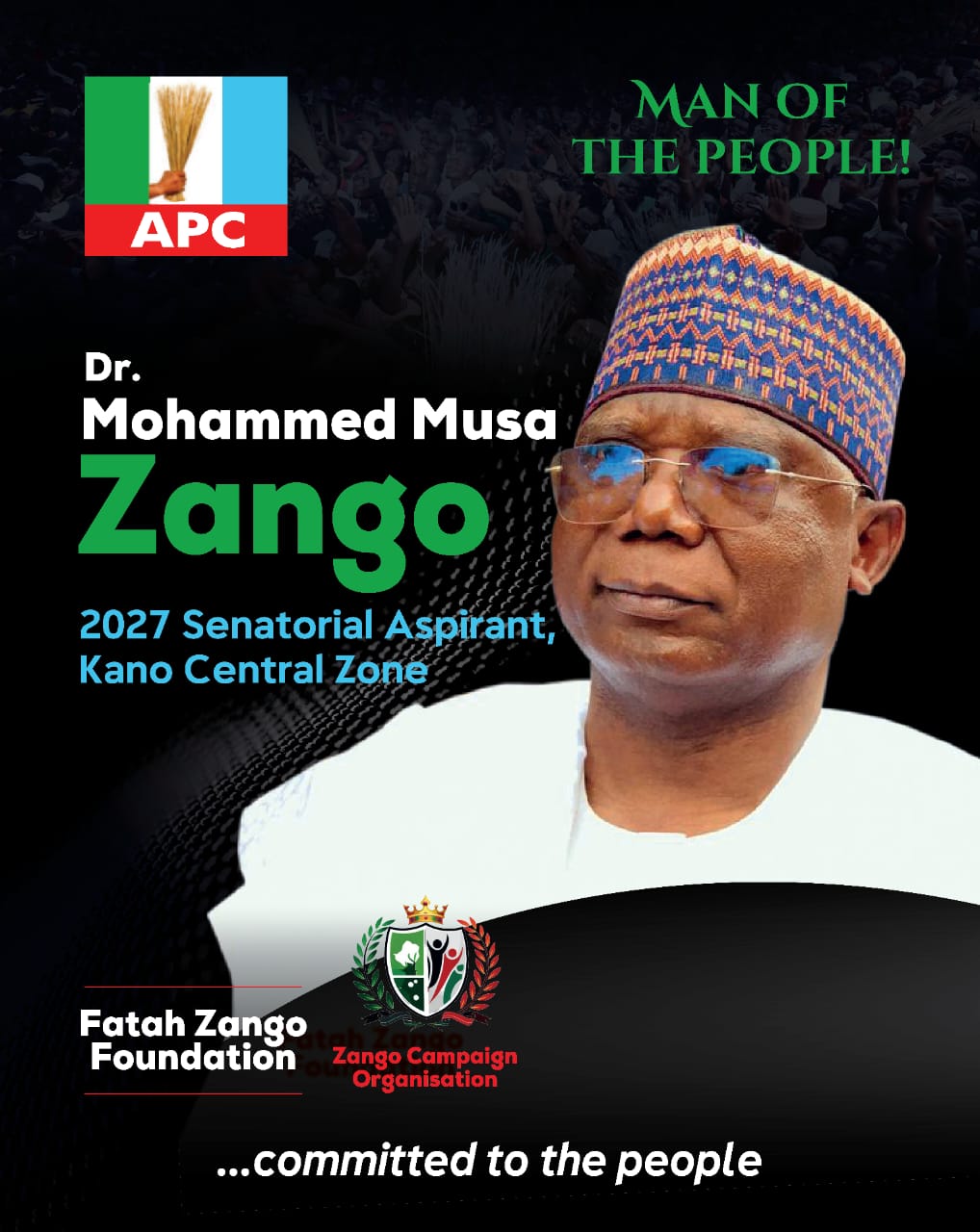
Zango Declares Kano Central Senate Bid, Rolls Out People-Centred 7-Point Rescue Agenda
Zango Unveils 7-Point Kano Central Agenda, Blends Grassroots Realities with Reform Alignment
Kano, Nigeria — May 3, 2026
Dr. Mohammed Musa Zango, FPSN, FNAPharm, has formally declared his intention to contest for the Kano Central Senatorial seat under the APC, delivering a speech that combined personal history, grassroots realities, and a structured policy agenda anchored on the “Kano First” vision of Governor Abba Kabir Yusuf.

Speaking at Mumbayy House in Kano, Zango framed his candidacy as a continuation of over two decades of humanitarian service through the Fatah Zango Foundation, positioning himself not as a career politician but as a practitioner stepping into public office.
He opened with a generational contrast that resonated strongly: recalling an era of free education and early employment opportunities, he questioned why such pathways have narrowed for today’s youth.
The framing was deliberate—linking past functional governance with present-day decline to justify his intervention.
Dr. Mohammed Musa Zango opened his declaration with a solemn verse from the Qur’an, affirming that ultimate power belongs only to Allah—who grants authority to whom He wills and takes it away as He pleases—setting a tone of humility and divine accountability for his ambition.
Focusing on his legislative intent, Zango stated that if given the APC ticket and subsequently elected, he would prioritise sponsoring and supporting laws to expand access to education, strengthen irrigation systems and food production, create sustainable jobs, and improve healthcare delivery, water access, and infrastructure across Kano Central. He further assured constituents that he would leverage his position in the Senate to attract federal projects and targeted funding to the zone, while aligning closely with the “Kano First” development agenda of Abba Kabir Yusuf.
Framing politics as a mission rather than a business, Zango’s commitments reinforced his message of service, positioning his candidacy as both a continuation of his humanitarian work and a strategic effort to translate grassroots impact into federal legislative action.

At the heart of his declaration was a seven-point agenda that addressed the most immediate and visible pressures facing Kano Central.
On education, he prioritised the removal of children from the streets through structured learning and vocational pathways, directly confronting the Almajiri crisis.
On agriculture, he emphasised irrigation, inputs, and storage—recognising that food inflation is not just an economic issue but a production and logistics failure.

His focus on youth, women, and persons with special needs reflects a broad-based inclusion strategy, though the credibility of this will depend heavily on how financing mechanisms are structured beyond campaign rhetoric.
Similarly, his healthcare and water commitments—backed by references to dire conditions such as outdoor medical treatments—highlight urgency, but also raise questions about delivery frameworks in a fiscally constrained environment.

Zango’s alignment with Governor Yusuf was explicit and strategic.
By openly endorsing the “Kano First” agenda and referencing ongoing state-level interventions, he positioned himself as a complementary federal actor rather than a parallel power centre.
This is politically astute, especially in a system where federal-state alignment often determines project flow.
Notably, he also referenced legacy industrial and healthcare initiatives initiated during the tenure of Abdullahi Umar Ganduje, including the AKK-linked industrial prospects, a multispecialty hospital, and a pharmaceutical manufacturing vision.
This signals a continuity argument—an attempt to bridge political divides by recognising past groundwork while aligning with current leadership.
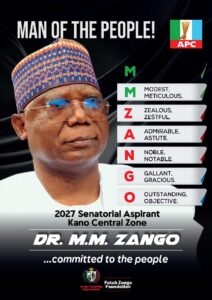

His commitment section leaned heavily on credibility built outside government. Over 20 years of philanthropy provides a tangible record, which strengthens his claim that his candidacy is mission-driven. However, philanthropy and legislative effectiveness are not the same. The real test will be whether he can translate community-level intervention into policy influence and federal resource mobilisation.
From a policy standpoint, his proposed role in the Senate is conventional but relevant: sponsoring laws, attracting federal projects, and strengthening state initiatives.
What remains less defined is the “how”—particularly in areas like funding models, legislative strategy, and coalition building within the National Assembly.
The speech also carried strong moral undertones, invoking the philosophy of Mallam Aminu Kano on justice over pity. This ideological anchoring gives his message cultural and historical depth, which is critical in Kano’s political landscape.

Assessment
Zango’s declaration stands out for its clarity of problems and alignment with lived realities. Unlike many aspirants who rely on abstract promises, he grounded his message in visible hardship—education gaps, food insecurity, weak healthcare systems, and infrastructure deficits.
Where the speech is strongest is in diagnosis and emotional connection.
Where it needs strengthening is in policy specificity and execution pathways. Voters increasingly expect not just intent, but mechanisms.
Politically, his alignment with Governor Yusuf is a strength, positioning him within an existing reform narrative rather than in opposition to it. Strategically, this increases his viability.
Overall, this is a credible, well-structured declaration that speaks directly to the needs of Kano Central. It signals a candidate who understands the terrain. The next phase of his campaign will determine whether he can move from a compelling voice to a convincing roadmap.

National Patriots Movement
Dr. Mohammed Musa Zango’s entry into the Kano Central senatorial race represents the kind of values-driven leadership Nigeria urgently needs. As Founder of the Fatah Zango Foundation, his long-standing humanitarian record reflects service beyond politics. His agenda speaks to real grassroots concerns—education, food security, healthcare, and dignity for the common man. The National Patriots Movement believes credible, people-focused aspirants like Zango will raise the standard of representation and restore public confidence in democratic governance.
Dr. G. Fraser. MFR.
Headlinenews.news Special Report.




